

Is wisdom tooth extraction mandatory before braces?
No, wisdom tooth extraction is not mandatory for every adult who wears or is about to wear braces. The decision depends on the position of the wisdom tooth, the space available on the arch, its condition (healthy, decayed, partially erupted) and the direction in which the orthodontist plans to move the teeth. In our clinic, this decision is always made by two specialists: the orthodontist establishes the plan for moving the teeth, while the surgeon assesses whether the wisdom tooth helps, hinders or is simply neutral in relation to that plan.
Good news for patients: in many cases, the wisdom tooth can stay in place. In others, extraction is recommended before or during orthodontic treatment, and the reasons are concrete and verifiable on the X-ray, not a rule applied automatically to everyone.
In our experience with adults starting orthodontic treatment, the question about the wisdom tooth comes up at almost every consultation. That is why we wrote this article: so you understand the real decision criteria before you come to the practice, rather than leaving with the impression that extraction is a standard step for anyone getting braces.
What role does the wisdom tooth play in dental crowding?
The wisdom tooth, known medically as the third molar, usually erupts between the ages of 17 and 25, meaning last of all, when the arch is already occupied by the other teeth. In many adults there is not enough room, so it remains partially erupted or completely impacted in the bone, meaning trapped under the gum.
A myth we often hear in the practice: "my wisdom tooth crowded my front teeth". The reality is more nuanced. Dental crowding in adults usually has several overlapping causes: the size of the teeth relative to the size of the jaws, the natural changes of the arch with age and, sometimes, the local pressure of a poorly positioned wisdom tooth. Blaming the wisdom tooth alone is an oversimplification, and extracting it merely in the hope that the crowding will resolve by itself is an unrealistic expectation that we prefer to correct from the very first discussion.
This is, in fact, one of the principles we have worked by since 2004: we explain from the start what expectations you can have given your particular situation. Extracting the wisdom tooth does not straighten crowded teeth on its own. It creates the conditions for orthodontic treatment or removes a risk factor, but the actual alignment is done by the braces.
In which situations do we recommend wisdom tooth extraction in adults with braces?
There are a few clinical situations in which extracting the wisdom tooth before or during orthodontic treatment is the right recommendation. We see them constantly in oral surgery practice:
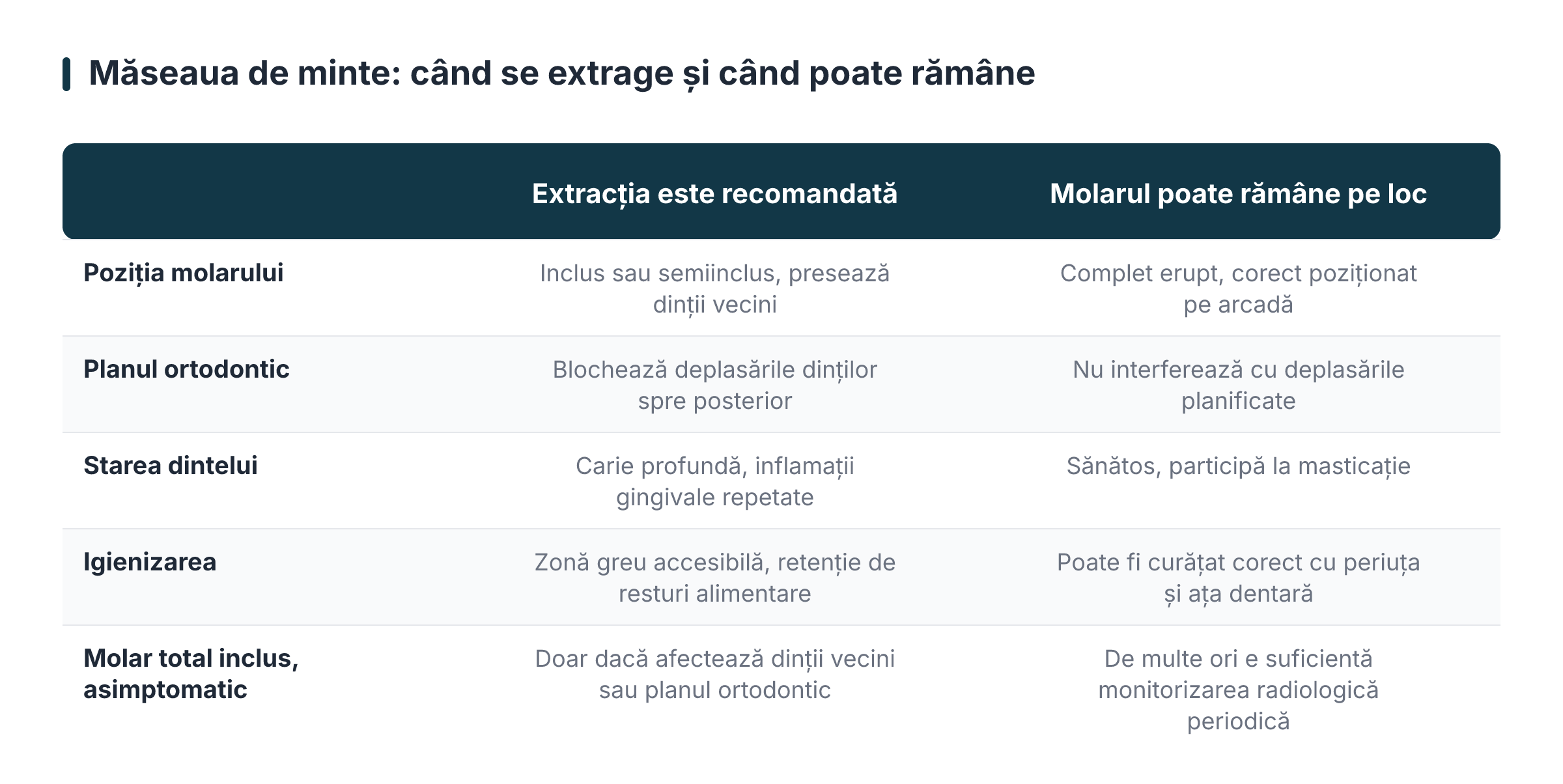
- An impacted or partially impacted molar pressing on the neighbouring teeth. When the X-ray shows that the wisdom tooth is pushing into the root of the second molar or lying horizontally in the bone, keeping it can complicate the movements planned by the orthodontist and can damage the adjacent tooth over time.
- The orthodontist needs space in the posterior area. In some treatment plans, the back teeth have to be moved backwards (distalisation). If the wisdom tooth blocks this path, extraction becomes part of the plan, not an option.
- A partially impacted molar with repeated episodes of inflammation. The gum that partially covers the tooth traps food debris and becomes inflamed (pericoronitis). During treatment with braces, oral hygiene is more difficult anyway, and a recurrent focus of inflammation at the back of the arch is a risk we prefer to eliminate before fitting the appliance.
- A deeply decayed or unrestorable molar. A tooth we cannot treat predictably anyway is not worth keeping for the duration of an orthodontic treatment lasting one or two years.
In all these cases, the timing of the extraction matters. As a rule, we prefer extraction before the braces are fitted, so that healing does not overlap with the adjustment period, but there are also plans in which the extraction is carried out along the way, depending on the stage at which the orthodontist needs the space.
When can the wisdom tooth stay in place?
It is just as important to say when we do NOT recommend extraction, because we do not recommend treatments the patient does not need, even though a plan with more procedures would be easier to "sell". The wisdom tooth can stay on the arch when:
- it is fully erupted, correctly positioned and has an opposing tooth to bite against (it takes part in chewing);
- it can be cleaned properly, meaning the patient can reach it with the toothbrush and dental floss;
- it does not interfere with the tooth movements in the orthodontic plan;
- it is completely impacted in the bone, deep, with no signs of damage to the neighbouring teeth, in which case periodic radiological monitoring alone is sometimes wiser than surgery.
The last situation deserves emphasis: a completely impacted, asymptomatic wisdom tooth with no contact with the adjacent roots is not extracted "preventively" as a reflex. Any surgical extraction carries its own risks and a healing period, and in adults the bone is denser than in teenagers, so the procedure is somewhat more demanding. We weigh the real benefit against the discomfort and the risks of the procedure, and if the balance does not clearly favour extraction, we tell you so openly.
How the decision is made: surgeon and orthodontist working together
What sets a sound decision apart from a hasty one is the evaluation from both perspectives. In our clinic on Șoseaua Pipera, where we have been working since 2014, the oral surgery specialist and the orthodontist we collaborate with analyse the same set of investigations together, and the patient receives a single coherent recommendation, not two contradictory opinions.
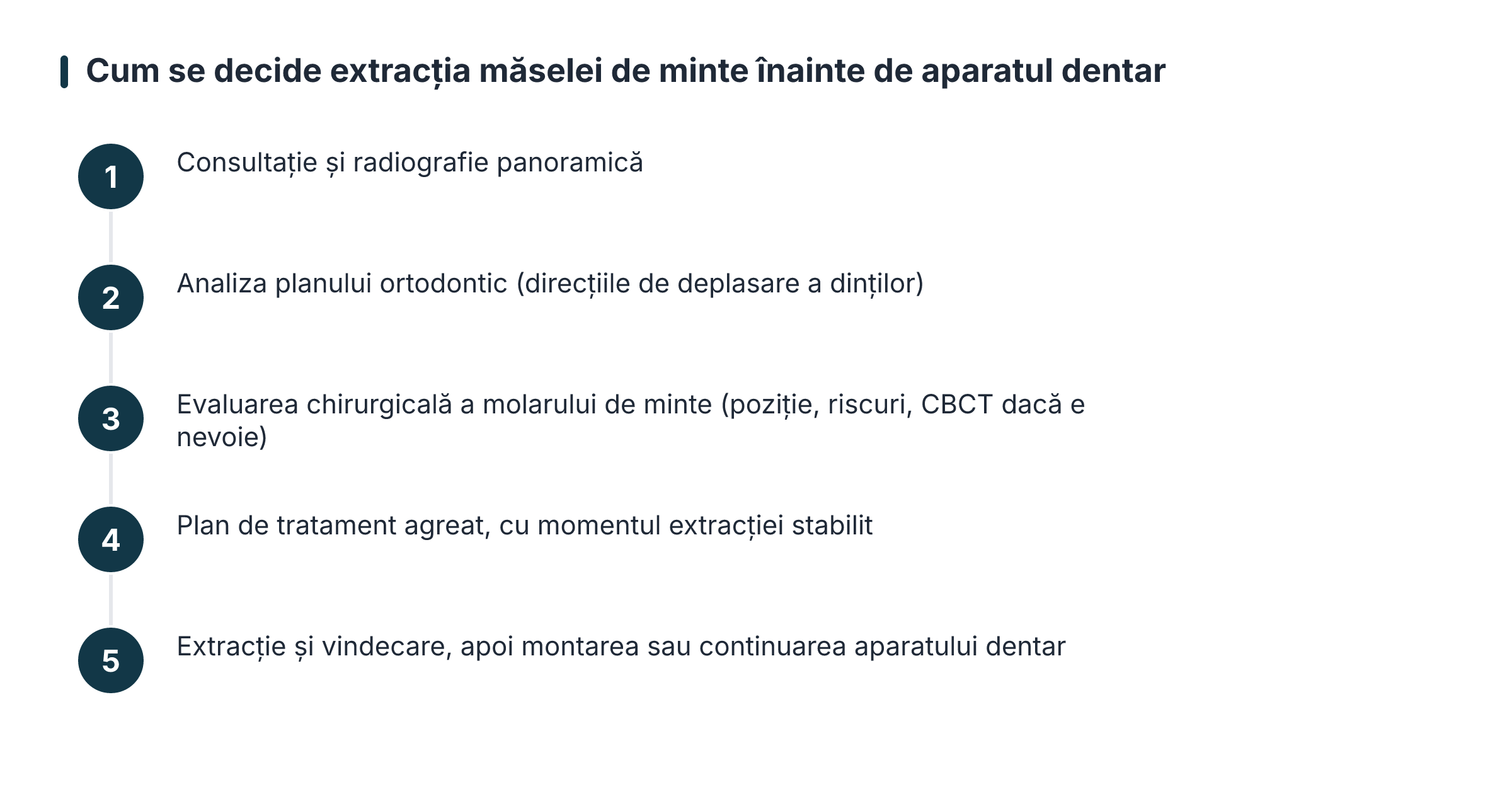
In practical terms, the evaluation follows a few steps:
- The consultation and the panoramic X-ray. We see the position of all the wisdom teeth, their relationship with the neighbouring teeth and with the important anatomical structures (the inferior alveolar nerve in the lower jaw, the maxillary sinus above).
- The orthodontic analysis. The orthodontist establishes the treatment plan: which teeth will be moved, in which direction and whether space is needed in the area of the wisdom teeth.
- The surgical evaluation. If extraction is necessary, we determine the degree of difficulty, the right timing in relation to fitting the braces and, where the relationship with the nerve or the sinus is close, an additional 3D investigation (CBCT) for safety.
- The plan agreed together with the patient. We explain why we do or do not recommend extraction, what the procedure involves and how it fits into the schedule of the orthodontic treatment. The prices agreed in the treatment plan remain unchanged throughout, provided the treatment takes place within a reasonable time frame, so you know from the start what to expect financially as well.
At this stage we also prepare the ground for the braces: before they are fitted, a professional cleaning with scaling and air flow is required, and if at the consultation we also find other problems, for example missing teeth that could be replaced with a dental implant after the teeth are aligned, we include them in the discussion from the start, so that the plan is complete rather than piecemeal.
How wisdom tooth extraction is performed in adults and what comes next
If the decision is extraction, here is what to expect. The procedure is done under local anaesthesia, so the area is numb throughout. For an erupted molar, extraction is usually quick. For an impacted or partially impacted molar, it is an oral surgery procedure: the tooth is exposed, sometimes sectioned so it can be removed while preserving the bone, and then sutures are placed.
In the days after the procedure, local swelling (oedema), some difficulty opening the mouth and discomfort manageable with the recommended medication are all normal. Most adult patients resume their usual activities within a few days, and the stitches are generally removed after about a week. You receive clear instructions from us: what to eat, how to clean the area and which signs you should report to us.
In relation to orthodontic treatment, the practical rule is to let the area heal before the braces are fitted or before adjustments are made in that area, with the exact schedule established together with the orthodontist. And if you are thinking about the combined cost of the extraction and the braces, there are instalment financing options for dental treatments, so that the agreed plan is not postponed for financial reasons.
Our conclusion, after years in which we have seen both scenarios: neither extracting all wisdom teeth "on principle" before braces, nor keeping them at all costs, is the right approach. The only valid answer is the one given by your specific situation, assessed by the surgeon and the orthodontist together. A consultation with a panoramic X-ray is the first step, and from there you receive a clear plan, logically explained, with realistic expectations from the outset.
Frequently asked questions
Do all four wisdom teeth have to be removed before braces?
Not necessarily. Each wisdom tooth is assessed individually, on the X-ray and clinically. It is possible that only one interferes with the orthodontic plan or is impacted in a problematic position, while the others can stay in place. In our clinic, the recommendation for extraction is made molar by molar, depending on position, condition and the directions of movement planned by the orthodontist, not as a standard package for all patients.
Will wisdom tooth extraction straighten my crowded teeth?
No. Extracting the wisdom tooth does not align the teeth on its own and does not resolve existing dental crowding. Crowding in adults usually has several causes, and the actual alignment is achieved by orthodontic treatment, with braces. Extraction can, however, be a necessary step in the plan, when the molar blocks tooth movement or represents a risk factor. This is exactly the kind of expectation we clarify from the first consultation.
When is the extraction performed: before the braces are fitted or during treatment?
It depends on the orthodontic plan. As a rule, we prefer extraction before the braces are fitted, so that healing does not overlap with the period of adjusting to the appliance. There are, however, situations in which the orthodontist needs that space only at a later stage, and the extraction is scheduled along the way. The exact timing is established together by the surgeon and the orthodontist, and you find it out from the treatment plan, before you start.
Does wisdom tooth extraction hurt in adults and how long does recovery take?
The procedure is performed under local anaesthesia, so the area is numb during the procedure. Once the anaesthetic wears off, some discomfort, local swelling and difficulty opening the mouth are normal, and they improve progressively over the first few days with the recommended medication. Most adult patients resume their usual activities within a few days, and the sutures are generally removed after about a week. You receive clear home care instructions.
I am over 40 and I want braces. Does the wisdom tooth still matter at my age?
Yes, assessing the wisdom teeth is part of the orthodontic consultation regardless of age. In adults the bone is denser and any extraction is somewhat more demanding than in teenagers, but this is not an obstacle in itself. What matters is the position of the molar, its condition and the treatment plan. If the molar is healthy, can be cleaned properly and does not interfere with tooth movement, it can stay in place even after the age of 40.
Should an impacted wisdom tooth that does not hurt be removed preventively?
Not automatically. A wisdom tooth completely impacted in the bone, with no symptoms and no signs of damage to the neighbouring teeth on the X-ray, can often simply be monitored periodically. Extraction becomes advisable when the molar presses on the root of the adjacent tooth, when it blocks the movements in the orthodontic plan or when episodes of inflammation occur. The decision is made on the basis of the X-ray and the treatment plan, weighing the real benefit against the risks of the procedure.
This article is for information purposes only and does not replace a specialist consultation. For a diagnosis and a personalised treatment plan, please book an appointment.