

Why do the questions you ask at the dental implant consultation matter?
At a dental implant consultation it is worth asking about four essential things: what exactly the diagnosis is and why the implant is the recommended solution, what stages the treatment involves and how long each one takes, what alternatives exist and why they were not chosen, and what the total cost is, with everything it includes. A dentist who answers all four clearly is in fact giving you a treatment plan you can follow logically from beginning to end.
We have been working in our clinic on Șoseaua Pipera since 2014, and the practice has been running since 2004. Over all these years we have noticed one thing that has become more pronounced: patients research the clinic and the treatment online even when they come with a clear recommendation from someone they trust. That seems natural to us. A dental implant is a long-term investment in your health, and an informed decision is made with questions, not with assumptions.
The patients we work best with are exactly those who follow the logical thread of the explanations: they want to understand why we recommend something, not just what we recommend. This article is written for them, as a checklist you can take with you to any implantology consultation, not only to ours.
Questions about the diagnosis: why do I need an implant and what is the recommendation based on?
The first set of questions clarifies your actual situation. Without a diagnosis you understand, the rest of the plan is left hanging in the air.
- What investigations is the plan based on? Implants require a three-dimensional scan (CBCT, a tomography of the jaw bones) that shows the volume and quality of the bone. A recommendation made "by eye" alone is incomplete.
- Do I have enough bone for an implant? If not, ask what bone grafting involves (augmentation, that is, rebuilding the missing bone) and how that changes the duration and the cost.
- Do the condition of my gums and neighbouring teeth allow an implant now? Sometimes periodontitis or active cavities have to be treated first. An honest dentist tells you this even if it means postponing the implant.
- Is there anything in my general health that matters? Uncontrolled diabetes, heavy smoking or certain medications influence healing and must be discussed openly.
In our clinic, explaining the diagnosis is the longest part of the consultation. We would rather spend an extra 20 minutes showing you on the images what we see than have you go home with a plan you do not understand. A patient who has understood why does not change their mind halfway through.
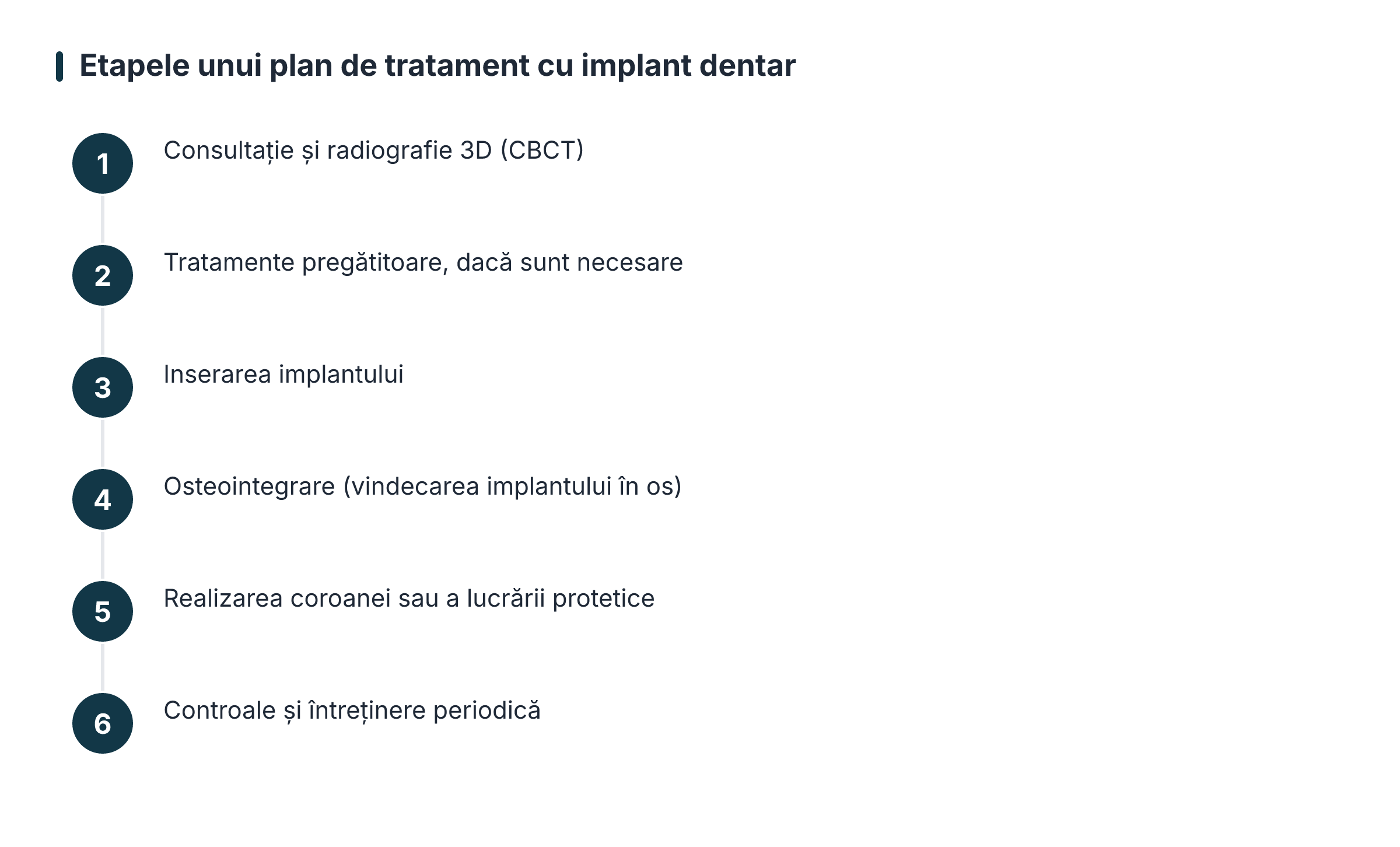
Questions about the stages of the treatment plan: what happens, in what order and how long does it take?
A dental implant treatment plan has clear stages, and you have the right to know all of them before you say yes. Here is what is worth asking:
- How many stages does my treatment have and what happens at each one? As a rule: preparation (any extractions, preliminary treatments, bone grafting if needed), placing the implant, the osseointegration period (the time during which the implant fuses with the bone, usually a few months), then making the crown or the prosthetic restoration.
- How long does it take in total, from the first procedure to the final tooth? The correct answer is a range, not a fixed date, because healing differs from person to person.
- Will I have a temporary tooth during the healing period? Especially for the front teeth, this question spares you unpleasant surprises.
- What happens if a complication arises along the way? You want to know how the clinic reacts, not just what the ideal scenario looks like.
What does a good answer to these questions look like?
A good answer is specific and in writing. With us, the patient leaves the consultation with the treatment plan set out in stages, with the estimated duration and the cost of each stage. If the dentist gives you vague answers ("we'll see as we go") to basic questions about the stages, it is a sign that the plan has not been thought through to the end for your situation.
Questions about alternatives: is an implant the only option for me?
In our experience, this is the question patients ask least often and the one that matters most. A principle we have held to since 2004: we recommend the treatment that is in the patient's interest, not the treatment we enjoy doing. To check that any dentist works this way, ask:
- What alternatives to an implant exist in my case? Depending on the situation, there may be bridges on natural teeth, dentures or, for extensive tooth loss, fixed restorations on several implants. Each has advantages and limits.
- Why do you recommend the implant and not the alternative? The answer must refer to your situation (your bone, your neighbouring teeth, your oral hygiene), not to generalities.
- Are there situations in which you would advise me NOT to have an implant now? Yes, there are: untreated periodontal disease, poor hygiene the patient is not ready to change, uncontrolled general conditions. A dentist who acknowledges this is protecting your interest.
- What happens if I do nothing? It is worth understanding the consequences of postponing too, such as the drifting of neighbouring teeth or bone loss, explained calmly, not as sales pressure.
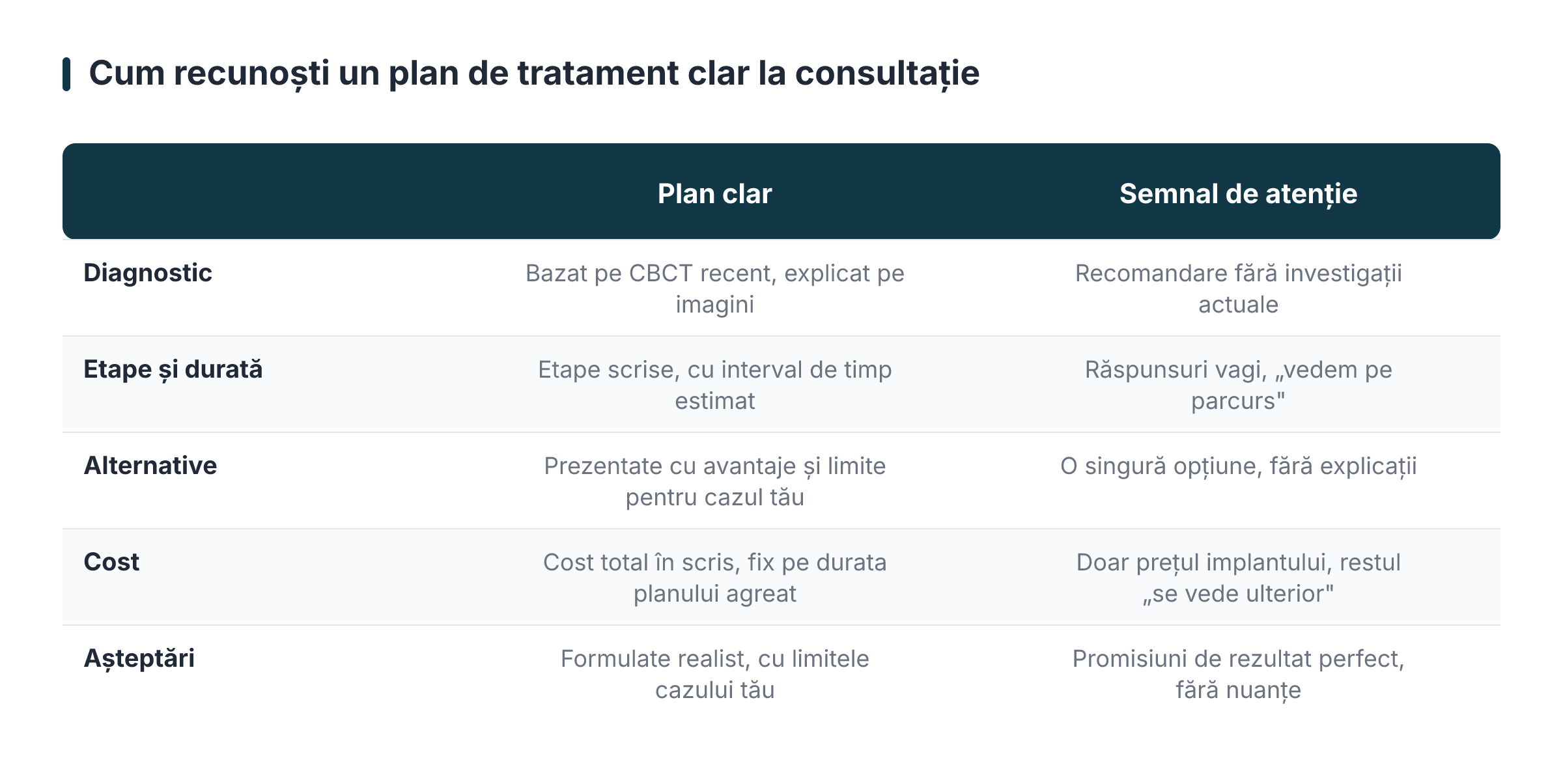
Questions about cost: what does the price include and can it change along the way?
Money is the subject patients hesitate most to press on, even though it is entirely their right. The right questions are:
- What is the total cost of the plan, not just of the implant? The price of an implant without the crown, without the abutment (the part that connects the implant to the crown) and without any bone grafting says little. Ask for the cost of the whole journey up to the final tooth.
- Does the agreed price stay fixed throughout the treatment? With us, yes: the prices in the agreed plan do not change during the treatment, as long as the treatment is carried out within a reasonable timeframe. We believe that a plan you accepted on the basis of a given cost must remain valid at that cost.
- What is not included in the price? Follow-up X-rays, preliminary treatments discovered along the way, temporary teeth. The clearer the list of exclusions is from the start, the fewer surprises there are.
- Are there instalment payment options? For more extensive plans, ask about the options for financing in instalments, so you can decide according to your real budget, not under pressure.
We cannot tell you in an article how much your treatment will cost, because it depends on the number of implants, on whether bone grafting is needed, on the type of prosthetic restoration and on the preparatory treatments. That is exactly why we insist that at the consultation you receive these figures in writing, for your own case.
Questions about realistic expectations: how will the result look and feel?
A habit we have had since we started: from the very first consultation we explain what expectations you can reasonably form given your situation. Not all cases start from the same point, and the result depends on the bone, the gums, oral hygiene and how disciplined you are about check-ups. As a patient, ask:
- How will the result look in my case, compared with the ideal cases in the photos? Showcase photographs usually show the most favourable situations. Your situation may be just as good, or it may have limits you deserve to know about in advance.
- What will I feel after the procedure and how long does recovery take? The discomfort in the first few days is normal and manageable, but it is good to know specifically what to expect.
- What responsibilities do I have as a patient? Rigorous daily hygiene, regular check-ups and professional cleanings, such as scaling with Air Flow, directly influence how well the implant behaves over time.
- How often do I need to come for check-ups once the restoration is finished? An implant does not "end" when the crown is fitted; it needs maintenance.
A dentist who sets your expectations realistically from the start, including the limits of your case, respects your intelligence and your time. A dentist who promises perfection without nuance deserves further questions.
How do you prepare practically for the implantology consultation?
To get the most out of the consultation, come prepared:
- Bring your existing medical documents: recent X-rays, the list of medications you take, information about general health conditions.
- Write your questions down beforehand. In the treatment room, with the emotion of the moment, half of them are forgotten. A written list, even on your phone, solves the problem.
- Ask for the plan in writing, with stages, durations and costs. It is normal to want to read it at home, in peace.
- Do not sign anything under pressure. A decision about an implant can wait a few days. If you sense the clinic is rushing you, that is a warning sign.
- Check where you are going. It is natural to look at the clinic online beforehand; you can see what our clinic in Pipera looks like before your first visit.
Whether you already have a recommendation for our clinic or you simply found us online, the implantology consultation is where all the questions in this article get answers for your specific case. Come with your list, we will come with the explanations.
Frequently asked questions
How long does a dental implant consultation take?
In our clinic, an implantology consultation usually takes between 30 and 60 minutes, because it includes the clinical examination, the analysis of the three-dimensional scan (CBCT) and, above all, the explanation of the diagnosis and the treatment options. The explanation part is the most important: we want you to leave understanding why we recommend a particular plan, not just with a list of procedures. If the situation is complex, we sometimes arrange a second appointment to present the final plan.
Do I need to bring an X-ray to the implant consultation?
If you have a recent panoramic X-ray or CBCT, bring them, because they help us discuss things concretely from the first visit. If you do not have any, that is not a problem: planning an implant requires an up-to-date CBCT in any case, which shows the volume and quality of the bone in three dimensions. What matters is that the final treatment plan is based on recent images of your situation, not on X-rays that are a few years old.
Can I receive the treatment plan and the cost in writing?
Yes, and we recommend you ask for it at any clinic. With us, the patient receives the treatment plan with the stages, the estimated duration and the associated costs, and the agreed prices do not change during the treatment, as long as it is carried out within a reasonable timeframe. A written plan allows you to read it at home, ask further questions and make the decision without pressure.
What do I do if I do not understand something in the dentist's explanations?
Ask again, without any embarrassment. Medical terms such as osseointegration, abutment or bone grafting cannot possibly be familiar to you, and it is the dentist's duty to explain them in terms you understand, with the help of the X-ray images if necessary. In our experience, patients who keep asking questions until they fully understand the plan are also the most satisfied along the way, because they know exactly what to expect at each stage.
Is it normal to ask for a second opinion before an implant?
Yes, it is completely normal and even healthy, especially with extensive or costly treatments. An honest dentist is not offended by your wish to check. If the second opinion differs significantly from the first, compare the arguments: what investigations each is based on, how the alternatives are explained and how transparent the total cost is. Differences in approach do legitimately exist, but you need to understand why each option is being recommended to you.
What happens if at the consultation I find out I cannot have an implant straight away?
This happens fairly often and it is not a final verdict. Most frequently, the reason is a problem that has to be resolved first: active periodontal disease, untreated cavities or insufficient bone that requires grafting. In these cases, the treatment plan includes the preparatory stage, and the implant follows once that has healed. We consider it more correct to postpone an implant than to place it in conditions that would reduce its long-term chances.
This article is for information purposes only and does not replace a specialist consultation. For a diagnosis and a personalised treatment plan, please book a consultation.