


How much does the dental implant hurt during the intervention?
The insertion of a dental implant is performed under local anesthesia, so that during the intervention the patient does not feel pain, but at most pressure and vibrations. Discomfort usually occurs after the anesthesia wears off and is, for most patients, moderate and manageable with common pain relievers recommended by a doctor. Immediate recovery generally takes a few days, and complete integration of the implant into the bone takes place over several months, depending on the clinical situation. The key to a good experience is to know from the beginning, concretely, what to expect at each stage.
In our clinic in Pipera Road, where we have been working with patients since 2014 and practicing dentistry since 2004, we have noticed a recurring thing: the fear of pain is almost always greater than the actual pain. Many patients tell us after the intervention that they felt less than during a regular dental extraction.
This does not mean that the experience is the same for everyone. A single implant, inserted into healthy bone, feels different than an intervention with multiple implants or with bone augmentation (a procedure by which insufficient bone is filled in). That is precisely why, at the consultation, we explain exactly what your case entails, not a general scenario.
Why don't we promise "zero pain"?
Each patient has a different sensitivity threshold and the complexity of the intervention varies from case to case. A clinic that promises the complete disappearance of any discomfort creates unrealistic expectations, and the patient who feels embarrassed the next day is needlessly scared, thinking that something went wrong.
Our approach is different: we tell you from the beginning what is normal to feel and what is not. This is, by the way, one of the principles by which we have been working for over 20 years, we only recommend what is in the patient's interest and we correctly explain the expectations before starting the treatment.
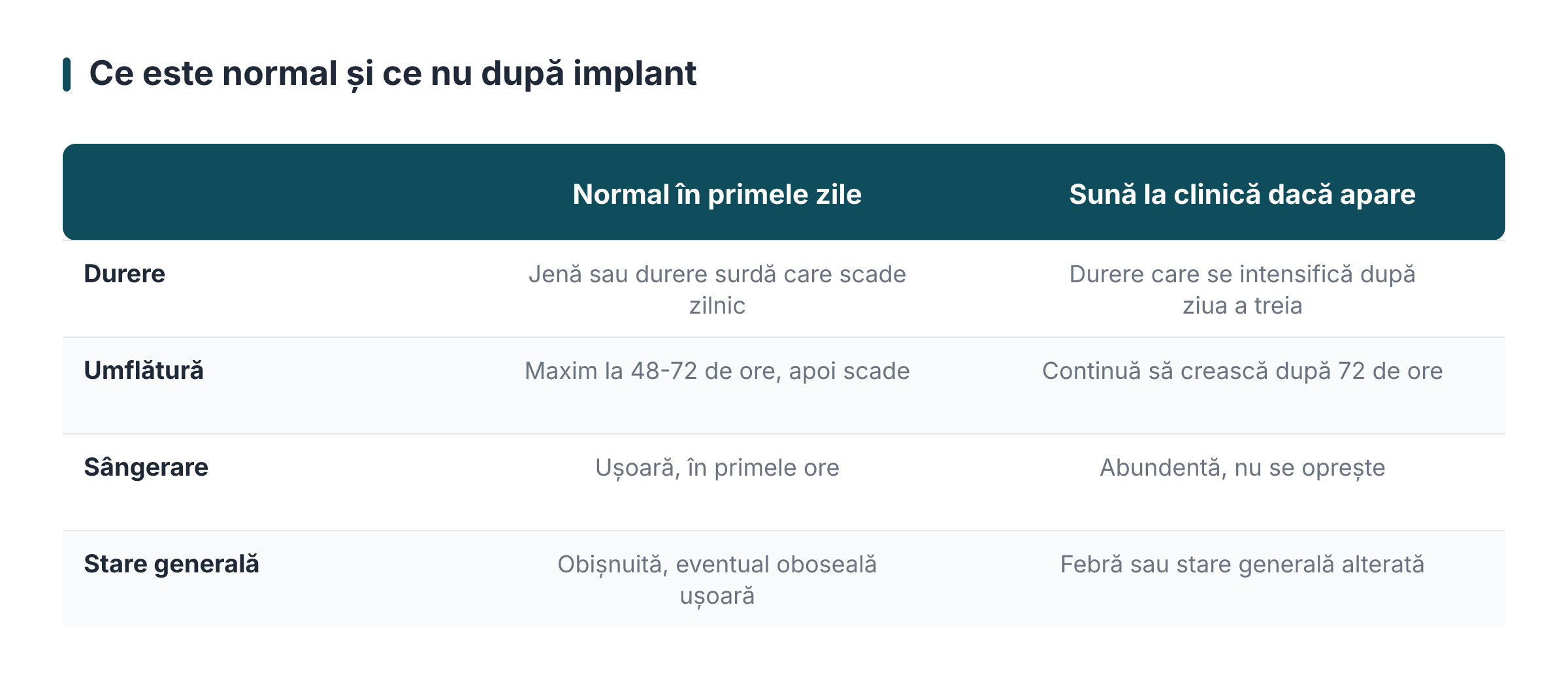
What is normal in the first days after the implant:
- dull pain or discomfort in the operated area, which yields to the recommended analgesics;
- swelling (edema) that peaks at 48-72 hours, then gradually decreases;
- a little bleeding or metallic taste in the first few hours;
- sometimes a subtle bruise on the cheek or gum.
What is NOT normal and requires a call to the clinic:
- pain that increases after the third day instead of decreasing;
- heavy bleeding that doesn't stop;
- fever or altered general condition;
- swelling that continues to grow after 72 hours.
When you know this distinction in advance, you go through recovery with much more peace of mind.
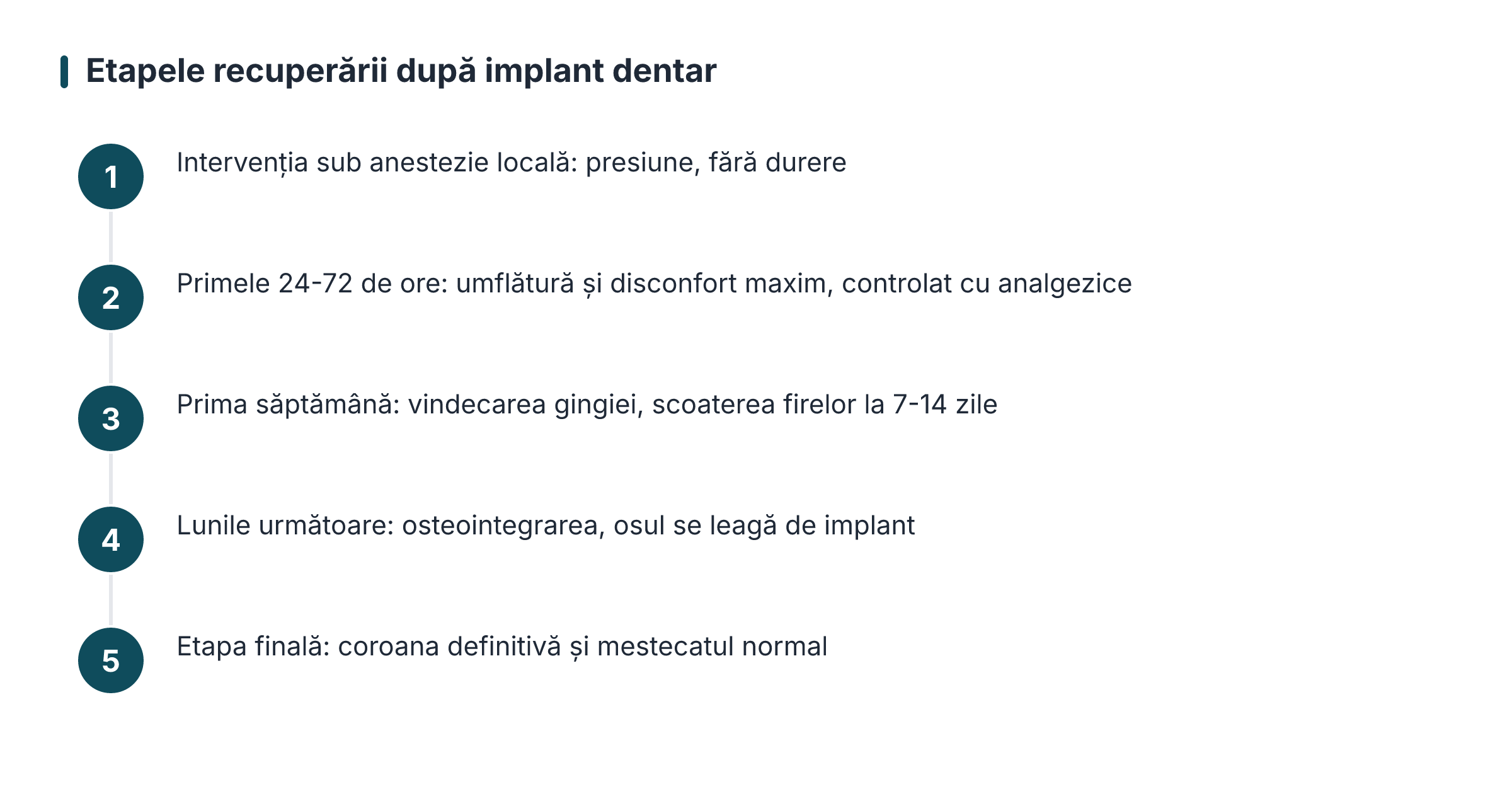
How long does dental implant recovery take, step by step?
Dental implant recovery has two distinct components that are worth understanding separately: the healing of the gums and soft tissues, which is felt in everyday life, and osseointegration, which is the biological process by which bone binds to the implant.
The first 24-72 hours: the period of maximum discomfort
This is the interval where you feel the intervention the most. Swelling and tenderness are normal, and pain relievers and cold compresses recommended by the doctor keep them under control. Most of our patients resume their usual office activities after one or two days, avoiding only intense physical exertion.
First week: gum healing
Discomfort visibly decreases from day to day. The gum is closed over the operated area, and the sutures are usually removed every 7-14 days, if they are not resorbable. During this period, careful hygiene and compliance with dietary recommendations are most important.
Next months: osseointegration
Although you already feel good, deep down the bone continues to bind to the surface of the implant. This process usually takes several months, depending on the quality of the bone, the area where the implant was inserted and the general state of health. Only after confirmation of osseointegration do we proceed to the stage of prosthetics on implants, i.e. making the definitive crown that will look and function like a natural tooth.
What influences pain and speed of healing after implant?
No two recoveries are the same, but there are clear factors that make a difference. We discuss them openly at the consultation, because some of them even depend on you:
- Complexity of the intervention: a single implant usually heals more easily than multiple implants or cases requiring bone addition or sinus lift (raising the sinus membrane to gain bone in the upper lateral area).
- Bone quality and quantity: dense and sufficient bone shortens and simplifies everything.
- Smoking: visibly slows gum healing and can affect implant integration. We recommend stopping or drastically reducing at least during the healing period.
- General diseases: uncontrolled diabetes, certain drug treatments or conditions affecting the bone require an adapted plan, they do not automatically exclude the implant.
- Oral hygiene and post-operative discipline: patients who follow directions almost always have a smoother recovery.
- Team experience and planning: a well-planned intervention, based on a three-dimensional X-ray, means less surgical trauma and faster healing.
All of these are assessed at the initial consultation. You also then receive the complete treatment plan, with clear costs that do not change during the agreed treatment, because it seems natural to us to know from the beginning what you are getting yourself into, both in terms of discomfort and budget.
How to reduce discomfort: our practical recommendations
Good recovery is mostly built at home in the early days. Here is what we recommend to our patients after inserting an implant:
- Apply cold compresses to the cheek in 10-15 minute increments for the first 24-48 hours to limit swelling.
- Take pain relievers exactly as prescribed, not just when the pain gets bad. It is easier to prevent pain than to stop it.
- Eat soft and warm for the first few days: soups, purees, yogurt. Avoid hot, strong or spicy foods.
- Do not rinse your mouth vigorously on the first day and do not touch the area with your tongue or brush; from the second day, follow the hygiene scheme indicated by the doctor.
- Avoid smoking and alcohol at least during the period indicated by the doctor.
- Sleep with your head slightly elevated for the first few nights to reduce edema.
- Come to your scheduled checkups, even if you feel fine. They allow us to confirm that the healing is proceeding correctly.
And a piece of advice we often give to anxious patients: come see the office before the procedure. You can take a look at the photo gallery of our clinic to familiarize yourself with the space and facilities. Anxiety decreases considerably when the place is no longer foreign to you.
When is it worth coming to a dental implant consultation in Pipera?
If you are missing a tooth or more, if you wear an uncomfortable denture, or if you have been putting off a decision for years due to fear of pain, an evaluation consultation is the natural step. It doesn't oblige you to do anything, but it gives you a concrete answer: what can be done in your case, how long it takes and how much it costs, with figures that remain valid throughout the agreed treatment.
For patients who seek us for a dental implant in the Pipera area and in Sector 1 of Bucharest, we have been in the same location on Pipera Road since 2014, with a small team in which the doctor who makes your treatment plan is the same one who treats you and follows you throughout the healing period. This continuity matters enormously in implantology, where the recovery spans months.
The honest bottom line, from experience since 2004: Dental implants hurt much less than patients fear, and recovery is predictable when expectations are properly explained from the start. This is exactly what we aim for at every consultation.
Frequently Asked Questions
How much does a dental implant hurt compared to an extraction?
Most of our patients describe the discomfort after the implant as comparable or even less than after a regular tooth extraction. The intervention itself is done under local anesthesia, so you don't feel pain, only pressure. In the following days, there is an embarrassment or a dull pain, which usually gives in to the painkillers recommended by the doctor. The intensity depends on the complexity of the case and the personal threshold of sensitivity, that's why we discuss the expectations concretely, during the consultation.
How many days of leave do I need after a dental implant?
For a single implant, many patients return to office work after one or two days. If your work involves physical exertion, loud talking or exposure to dust, it is prudent to take a few extra days off. For larger interventions, with multiple implants or bone addition, we usually recommend a more generous rest interval. We establish together, before the intervention, a realistic plan adapted to your schedule, so that you have no surprises.
What am I allowed to eat after inserting the implant?
In the first days we recommend soft and warm foods: creamy soups, purees, yogurt, soft eggs, boiled fish. Avoid hot, hard, crunchy or highly spicy foods, as well as fizzy drinks and alcohol. Chew on the side opposite the operated area. As the discomfort subsides, you gradually return to your regular diet, usually within one to two weeks. You receive written instructions from us, adapted to your intervention, so that you don't have to remember everything from the discussion.
How long until I can chew normally on the implant?
Normal chewing, with full force, is only possible after the definitive crown has been fitted, i.e. after the bone has completely integrated with the implant. This process usually takes several months, depending on the quality of the bone and the treated area. Until then, the gum heals in a week or two and you function normally, just protecting that area. At the consultation, we present you with the complete calendar of your case, with all stages and estimated durations.
What if the pain doesn't go away after a few days?
The simple rule we give our patients: the pain should decrease day by day. If after the third day the pain intensifies, a fever appears, the swelling increases or you notice bleeding that does not stop, call the clinic. Most of the time it's a minor irritation or problem that resolves quickly, but it's important to have it evaluated by a doctor. Our patients always have a direct contact for such situations.
Can I get a dental implant if I smoke or have diabetes?
In many cases, yes, but with a tailored plan. Smoking slows healing and increases the risk of complications, so we recommend stopping or cutting down drastically at least during the healing period. Properly controlled diabetes does not rule out an implant, but requires collaboration with your doctor and closer monitoring of healing. At the initial consultation we assess your complete situation and openly tell you what is realistic in your case, including the specific risks.
More details: our dental implant page for Sector 1. See also the instalment payment options.
This article is informative and does not replace specialist consultation. For a personalized diagnosis and treatment plan, schedule a consultation.