

The short answer: how to choose the right clinic for a dental implant in Bucharest
If you are wondering where to get a dental implant in Bucharest, the right answer is not the name of a clinic, but a set of criteria you can check for yourself: the experience and training of the implantologist, a written treatment plan with a final price, the implant system used, access to imaging investigations (dental CT scan), the way the risks and alternatives are explained to you, and cost transparency. A serious clinic passes the test on all of these points, regardless of its size or advertising budget.
At our clinic on Șoseaua Pipera we work with patients who often come through recommendations, but who, quite rightly, check online before booking an appointment. That is a healthy habit and we encourage it. This article sets out in writing exactly the criteria by which we would want to be assessed ourselves, because they are the criteria that genuinely predict a successful treatment.
One thing we say from the outset: the clinic that is most visible in advertising is not automatically the most suitable one for your case, and the cheapest offer rarely includes everything you need. The guide below helps you make a fair comparison.
The 10 criteria that really matter when choosing an implant clinic
After years of consultations in which patients brought us quotes from other clinics to compare, we have noticed that most people compare a single thing: the price per implant. It is the easiest criterion to compare and, unfortunately, the most misleading. Here is the complete list we recommend:
- The dentist's experience and training in implantology. Ask directly: how many years they have been placing implants, what postgraduate training they have (master's degree, certification in implantology), how many cases similar to yours they have treated. An experienced dentist does not shy away from these questions.
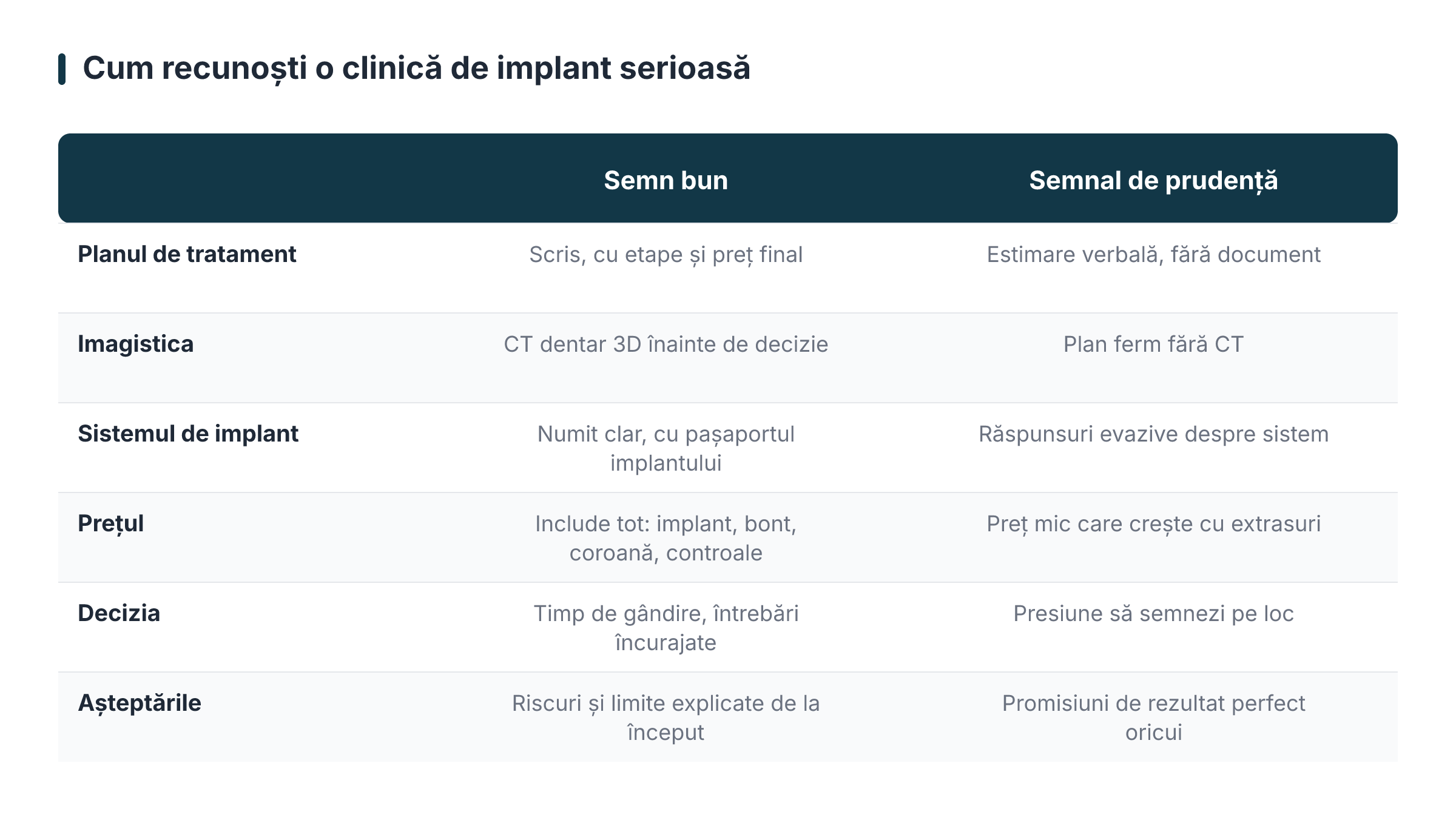
- A written treatment plan, with stages and a final price. Not a verbal estimate, but a document you can take home and study. At our clinic, the price agreed in the plan does not change along the way, provided the treatment is carried out within a reasonable time frame.
- 3D imaging (dental CT scan) before any decision. The position of the implant is planned on the real bone volume, not on a simple panoramic X-ray. If you are offered an implant without a CT scan, ask for clarification.
- The implant system used. There are well-established systems with decades of clinical documentation and prosthetic components available in the long term. Ask which system is used and why, and whether you will receive the implant passport (the document stating the type and serial number of the implant).
- Who handles the prosthetic part. The implant is only the artificial root; the crown on top determines how you look and how you chew. Clinics that also provide fixed prosthetic work on implants manage the case from start to finish, without sending you from one practice to another.
- Honesty in the recommendation. A good sign is when the dentist also tells you what is NOT worth doing, or when they suggest the simpler option rather than the most expensive one. The patient's interest must come before the dentist's preferences.
- Realistic expectations explained from the start. The actual duration of the treatment, the healing period, what happens if there is not enough bone, how the result will look in your specific situation. Promises such as "new teeth immediately, in any situation" deserve to be viewed with caution.
- Cost transparency. The price quoted must state clearly what it includes: the implant, the abutment, the crown, the investigations, the check-ups. A low price that later grows with "extras" is not a low price.
- Continuity of the team. An implant is monitored for years. A clinic where the dentists are the same year after year gives you continuity at check-ups, rather than a different dentist at every visit.
- How you feel at the consultation. Did you get answers to all your questions? Did you understand the logic of the plan? If you leave with more uncertainties than you arrived with, that is a signal worth taking into account.
Why the lowest price is not a selection criterion
Cost matters, obviously, and nobody should feel guilty for asking about it. The problem arises when price becomes the only criterion, because the offers are not comparable with one another: one includes only the implant, another includes the implant, abutment and crown, another also adds the investigations and the check-ups.
Our practical recommendation: at every clinic you assess, ask for the final price of your complete case, in writing, with everything it includes. Only then are you comparing like with like. We have explained the correct structure of an implant price on our dental implant page, where we also describe the stages of the treatment.
If budget is the main constraint, the honest solution is not the cheapest implant, but an open discussion about staging the treatment or about payment in instalments. A good plan can be adapted to a budget without compromising the quality of the implant or of the crown.
What factors actually influence the cost of an implant
To understand the price differences between clinics, look at these factors: the implant system used, the need for bone grafting or a sinus lift (the bone augmentation procedure in the upper lateral area), the type of final crown, the number of implants and the prosthetic complexity. Large price differences almost always have a technical explanation. Ask for it.
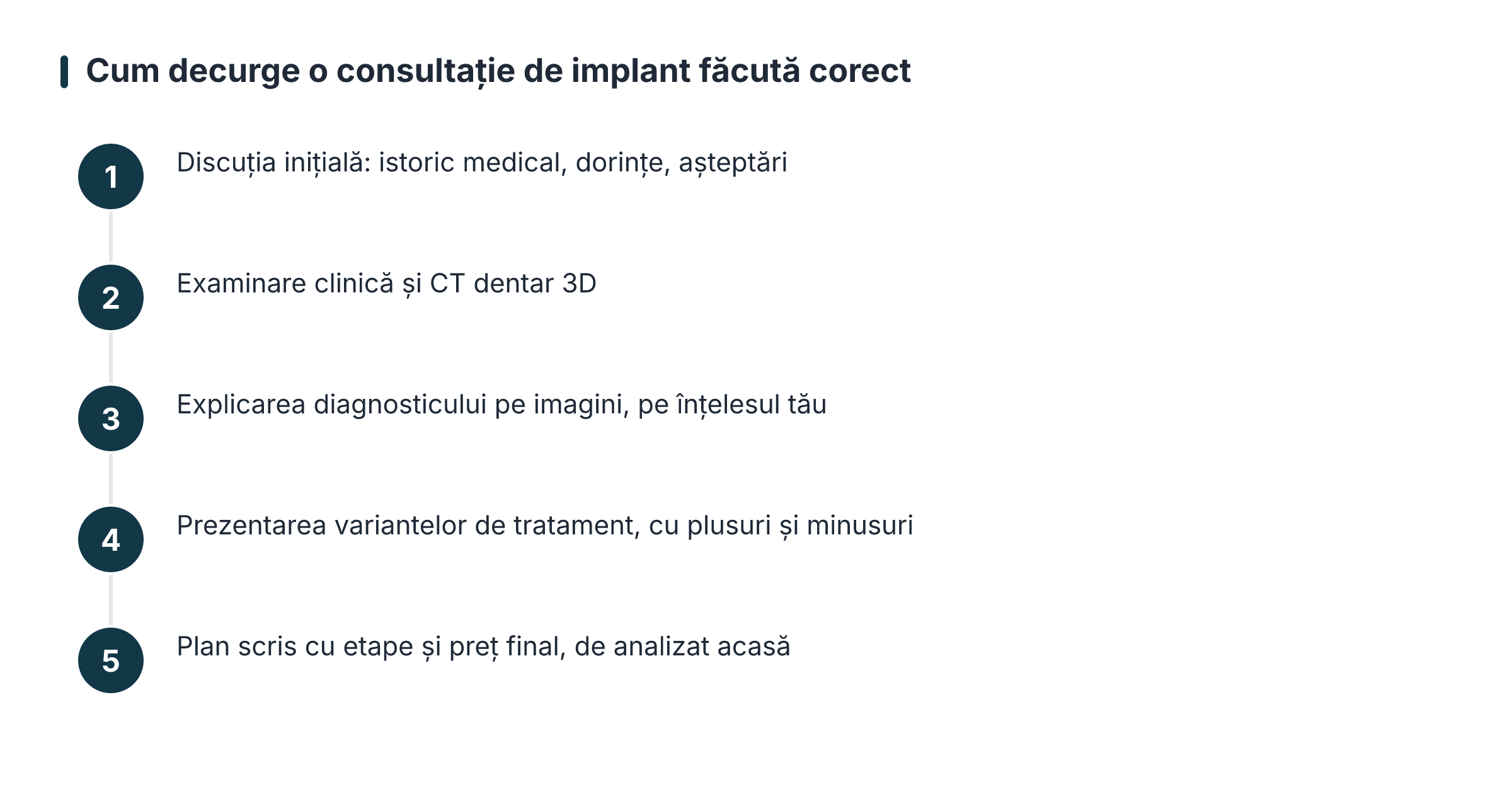
What a properly conducted implant consultation looks like, step by step
The best test of a clinic is the first consultation itself. Here is how it goes with us and what you should essentially find anywhere you are treated:
- The initial discussion. The dentist listens to you: what is bothering you, what you want, what your medical history is. General conditions (diabetes, osteoporosis, anticoagulant treatment) and smoking influence the plan, so they must be discussed openly.
- The clinical examination and imaging. An examination of the oral cavity, plus a dental CT scan (taken outside the clinic, at an imaging centre) to assess the bone volume and the important anatomical structures (the alveolar nerve, the maxillary sinus).
- Explaining the diagnosis. You are shown on the images what the situation is, in words you can understand. If anything remains unclear, you keep asking until it becomes clear.
- The treatment options, with pros and cons. There is rarely only one solution. A fair dentist presents the alternatives, including those they do not provide themselves, and tells you what expectations are realistic in your case.
- The written plan and the final price. You go home with the document, study it without pressure and come back with questions. A decision made under pressure at the first visit is not a good decision.
The patients we work best with are those who follow the logical thread of the explanations and decide with full knowledge of the facts. That is why we invest time in this stage: a patient who has understood the plan gets no surprises along the way.
Warning signs: when to seek a second opinion
Just as important as the list of criteria is the list of signals that should make you cautious:
- You are offered a definitive plan and a firm price without a dental CT scan and without a complete examination.
- You receive nothing in writing, only figures given verbally or over the phone.
- You are not told which implant system is used, or you get evasive answers.
- You are pressured into signing on the spot, with an "offer valid today only".
- You are promised a perfect result with no discussion whatsoever about risks, bone healing or the situations in which the plan may be adjusted.
- The initial price increases along the way with items that were foreseeable from the start.
None of these signals automatically means you will be treated badly, but each one justifies a second opinion. An extra consultation costs little compared with a treatment that stretches over months.
Does the clinic's location matter? About dental implants in Pipera and the northern area
Location is not a medical criterion, but it is a practical one you cannot ignore: implant treatment involves several visits over a few months (placing the implant, check-ups, impressions, the try-in and fitting of the crown), plus regular check-ups for years afterwards. A clinic you can reach easily from home or from the office makes the difference between check-ups that are kept and check-ups that are postponed.
For patients in the northern part of Bucharest, Pipera, Aviației, Aurel Vlaicu, the short distance to the clinic is precisely the reason why post-implant check-ups actually happen. We have been treating patients at the Șoseaua Pipera location since 2014, and the clinic's experience goes back to 2004, which means that many of our implant patients have been monitored for years by the same team. If you would like to get an idea of the practice and its equipment before booking, you can view the clinic gallery.
The practical conclusion: choose first according to the medical criteria in this guide, then, among the clinics that meet them, choose the one you will still reach effortlessly two years from now. And if you want to test these criteria on your specific case, an assessment consultation is the natural first step: you come with the questions from this article and leave with a written plan you can compare at your leisure.
Frequently asked questions
How can I tell whether a dentist has real experience in implantology?
Ask directly at the consultation: how many years they have been doing implantology, what postgraduate training they have (a master's degree or certification in implantology) and how many cases similar to yours they have treated. You can also check the dentist's right to practise in the public online registers. An experienced dentist answers these questions naturally, without feeling offended. Be cautious only if you get evasive answers or if you are not told exactly who will be carrying out the procedure.
Is it better to choose a large clinic or a small one for a dental implant?
The size of the clinic does not predict the quality of the treatment. What matters is the dentist who treats you, the written plan, the 3D imaging, the implant system and the continuity of follow-up over time. Large clinics may have extensive equipment, but sometimes you see a different dentist at every visit. Smaller clinics with a stable team offer continuity: the same dentist sees you from the consultation through to the check-ups years later. Apply the same criteria regardless of size and choose the clinic where you find all of them.
Why do implant prices differ so much between clinics in Bucharest?
Because the offers do not include the same things. Some prices cover only the implant itself, others also include the abutment, the crown, the investigations and the check-ups. The implant system used also differs, and cases that require bone grafting or a sinus lift cost more. That is why the only fair comparison is between complete written plans, with a final price for your case. Ask each clinic for the exact list of what the quoted price includes.
Can I visit several clinics for opinions before I decide?
Yes, and it is actually recommended for a treatment of this scale. A second opinion helps you compare the plans, the final prices and the way your situation is explained to you. Take along the investigations you have already had (the dental CT scan can be reused if it is recent) so that you do not repeat them needlessly. A fair dentist is not upset that you are also seeking another opinion; on the contrary, a patient who has compared options and understood the plan is the patient with whom collaboration works best.
What does it mean that the price does not change during treatment?
It means that the price agreed in the written treatment plan remains valid for all the stages described in the plan, provided the treatment is carried out within a reasonable period of time. At our clinic this is a working principle: what we agreed at the start is what you pay at the end. Exceptions can arise only if the clinical situation changes significantly (for example, a complication independent of the plan), and in that case the discussion is reopened transparently, before any additional procedure.
How long does the whole implant treatment take, from consultation to the final crown?
It depends on the case. After the implant is placed comes the osseointegration period, that is, the healing during which the bone bonds with the implant, which usually takes a few months. If bone grafting or prior extractions are needed, the total duration increases. Only after osseointegration is the final crown made. At the consultation you receive an estimated timeline for your specific situation, with the stages and the intervals between them, so that you can plan your visits realistically.
This article is for information purposes only and does not replace a specialist consultation. For a diagnosis and a personalised treatment plan, please book a consultation.