

What maintenance does a prosthetic work on implants have?
A prosthetic work on implants needs three things to last over time: rigorous daily hygiene, adapted to the area around the implants, periodic checks at the office once or twice a year and regular professional hygiene. The implant does not decay, but the tissues around it can become inflamed if the bacterial plaque accumulates, and the components of the work need periodic technical checks. With this maintenance, an implant work can work for many years, often decades.
Many patients ask us this since the first consultation, and rightly so. Implant prosthetics is a significant investment, and the decision must be made with knowledge. In our clinic, we explain from the beginning what expectations are realistic according to each person's situation, precisely so that the patient knows what follows after the work is fixed, not just how it looks on the day of delivery.
The good news is that maintenance doesn't involve anything complicated or painful. It's about daily habits of a few minutes and short visits to the office, planned ahead of time. In this article we break down each component so you know exactly what to expect.
Why does a work that cannot decay need care?
It is a common question: if the implant is titanium and the crown is ceramic or zirconium, what can go wrong? The answer lies in the living tissues surrounding the implant.
A natural tooth is attached to the bone by a ligament containing defense fibers and receptors. The implant integrates directly into the bone, without this ligament, which means that the gum around it defends itself a little differently from the aggression of the bacterial plaque. If plaque builds up, peri-implant mucositis can occur, an inflammation of the gum around the implant, which is reversible if treated in time. Untreated, it can evolve into periimplantitis, that is, an inflammation that also affects the supporting bone, a situation that is much more difficult to manage.
That is why hygiene around implants is not optional, but the main condition of longevity. In addition to the biological component, there is also a mechanical one: the fastening screws, contact points and chewing surfaces are checked periodically, just like you technically check a good car, even if it runs flawlessly.
Daily hygiene at home: what you need to do specifically
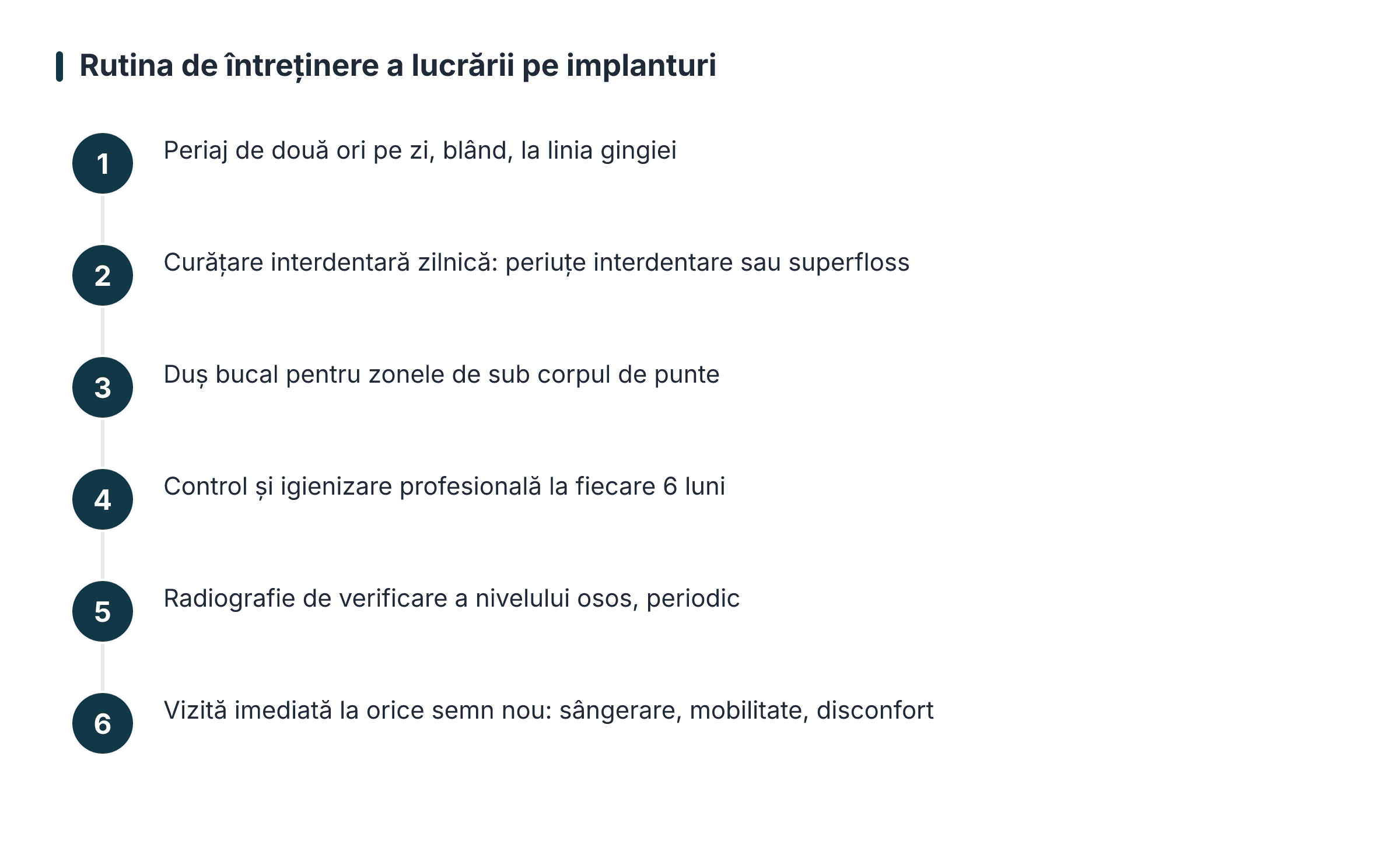
The daily routine for an implant job is similar to that for natural teeth, but with a few extra tools. We recommend to our patients:
- Brush twice a day, with a soft hand brush or electric brush, gently insisting on the gum line, where the crown meets the soft tissue.
- Interdental brushes of suitable size, for the spaces between the elements of the work. We'll show you the correct size at the cabinet, it's not guesswork.
- Oral douche (oral irrigator), very useful especially for extended work on multiple implants, where it cleans the areas under the bridge body, hard to reach with a brush.
- Special dental floss for implants (superfloss), where the design of the work allows it.
When handing over the paper, we show each patient, on their own paper, how to use these tools. Each prosthetic construction has its own geometry, and a five-minute demo does more than any general list.
Signs to look out for at home
Contact the practice if you notice: gum bleeding when brushing in the area of the implants, local redness or swelling, persistent unpleasant taste or smell, sensation of mobility of the work or a new noise when chewing. None of these signs automatically mean a serious problem, but they're all worth a quick check. The earlier we intervene, the simpler the solution.
Periodic control of implants: what happens in the office
Periodic control of implants is the second essential component of maintenance. In general, we recommend a visit every six months, and in patients at higher risk, for example smokers or people with a history of periodontal disease, the intervals may be shorter. We determine the exact frequency individually.
On a routine check we check:
- The condition of the gums around the implants, to detect any inflammation in time.
- Stability of the work and set screws, as slight loosening is easily corrected if caught early.
- Occlusion, i.e. how the work comes into contact with the opposing teeth; contacts can change over time and rebalance through fine-tuning.
- Bone level, through control radiographs performed periodically, not at every visit.
- Professional hygiene, with special tools that do not scratch the surfaces of the implant and the work.
Such a visit usually lasts under an hour and is painless. You can see the equipment with which we work on these controls in the gallery of our office in Pipera, where we have been operating since 2014.
How long does a dental implant and the work on it last?
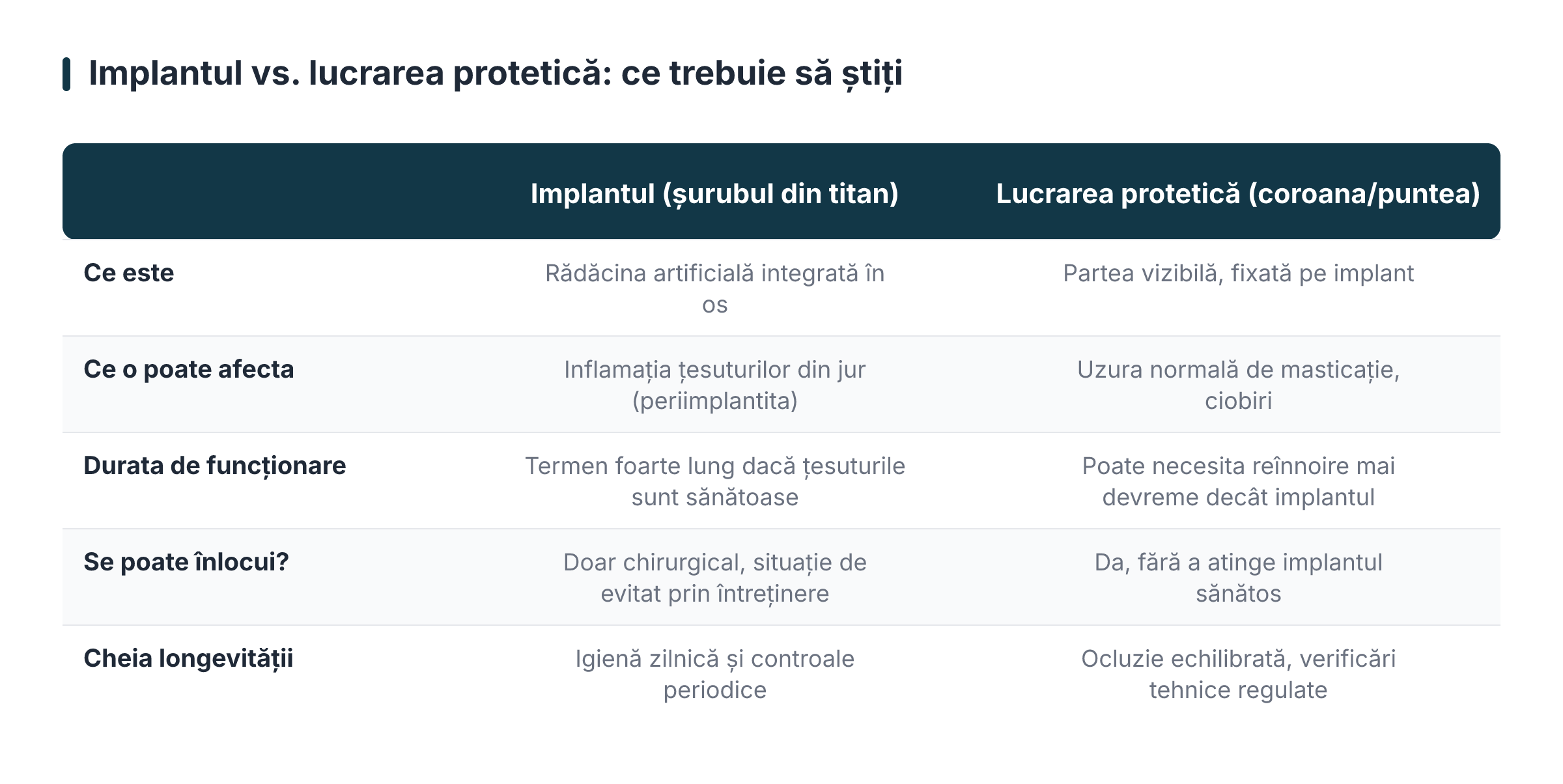
The question "how long does a dental implant last" does not have a single answer, because longevity depends on several factors, and promises with exact figures would not be fair to the patient. What we can say from the clinical experience accumulated since 2004 is that well-integrated and properly maintained implants frequently function for many years, often decades, and the prosthetic component, the crown or bridge, may require renewal earlier than the implant itself, due to normal wear and tear of the materials.
It is useful to distinguish between the two components:
- The implant, the titanium screw integrated into the bone, which can remain functional for a very long time if the surrounding tissues are healthy.
- Prosthetic work, crown or bridge fixed to the implant, subject to chewing wear, which can be replaced without touching the implant, when necessary.
The factors that influence the life span the most are: the quality of daily hygiene, attendance at check-ups, smoking, general diseases such as uncontrolled diabetes, bruxism (teeth grinding, which overburdens work) and the quality of initial planning. You can read about how we evaluate the situation of each patient before treatment on our page about dental implant.
What you can do to extend the life of your work
The part that depends on the patient is surprisingly large. Daily hygiene and check-ups cover the essentials, but a few more habits are important: avoid breaking hard objects with your teeth such as walnut shells or ice, wear a protective mouth guard if we have recommended it for bruxism, and do not postpone the visit when you feel that something has changed. Smoking remains one of the most important risk factors for the tissues surrounding implants, and reducing or quitting has direct and measurable benefits to controls.
What life with an implant job looks like in a nutshell
Beyond the rules, everyday life with prosthetic work on implants is very close to that of healthy natural teeth. Eat normally, talk normally, smile normally. The real difference is discipline: a few minutes of careful hygiene every day and two short visits a year to the office.
In our clinic, the maintenance plan is part of the treatment plan discussed from the beginning, with fixed and unchanged costs during the agreed treatment, when it is carried out in a reasonable interval. We only recommend what is in the patient's best interest, and if your situation does not require a certain procedure, we openly tell you so.
If you already have implant work done elsewhere and haven't had a follow-up in a long time, an evaluation consultation is the best place to start. And if you are just documenting yourself before the treatment, always include in the discussion with the doctor the topic of maintenance, not just the intervention itself. It is the sign of a long-term plan.
Frequently Asked Questions
How often do I have to go for check-ups after I have work on implants?
In general, we recommend a checkup every six months combined with professional sanitization. In patients with risk factors such as smoking, bruxism or a history of periodontal disease, we can set shorter intervals of three or four months. The exact frequency is determined individually, depending on the condition of the gums, the extent of the work and how well you manage to maintain hygiene at home. It is important that these visits are regular, because most problems surrounding implants evolve slowly and silently, and if detected early, they are easily solved.
Can I use the electric brush and oral shower on the implant work?
Yes, both are not only allowed, but even recommended. The soft-headed power brush effectively cleans the gum line, and the oral douche (oral irrigator) is particularly useful for extended work on multiple implants, where it cleans areas under the bridge body that are hard to reach with a brush or floss. The only recommendation is to use moderate pressure and, with the irrigator, a medium intensity level in the gum area. When handing over the work, we show you concretely how to use each tool on your construction.
What happens if the gum bleeds around the implant?
Bleeding when brushing in the implant area is the most common sign of peri-implant mucositis, which is an inflammation of the gums caused by bacterial plaque. The good news is that, at this stage, the situation is usually reversible with a professional cleaning and correcting the hygiene technique at home. Don't ignore the sign and wait for it to go away on its own, because untreated inflammation can progress to the supporting bone. Call the office and schedule a checkup; early intervention is simple, quick and much less expensive than treating an advanced problem.
Can the crown on the implant be replaced without removing the implant?
Yes, in the vast majority of cases. The implant and the prosthetic work are separate components: the implant is the screw integrated into the bone, and the crown or bridge is fixed to it by screwing or cementing. If, after years of use, the crown wears, chips, or you want an aesthetic improvement, it can be replaced without touching the implant, provided it is healthy and well integrated. This is one of the major advantages of prosthetics on implants over other solutions: the worn component changes, the foundation remains.
Does smoking affect implants and prosthetic work?
Yes, smoking is one of the most important risk factors for the tissues around implants. It reduces blood supply to the gum, masks early signs of inflammation such as bleeding, and makes healing more difficult. Basically, in smokers, the problems appear more often and are seen later, exactly the combination we don't want. We do not refuse treatment to smoking patients, but we explain these risks to them from the beginning and recommend more frequent check-ups. Any reduction in smoking has a real benefit for the health of the tissues around the implants.
Does professional implant hygiene differ from regular scaling?
Yes, there are important differences. The surfaces of the implant and the prosthetic work must not be scratched, because microscratches favor the subsequent accumulation of bacterial plaque. That's why we use special tools, with tips made of softer materials than titanium, and adapted polishing methods. The procedure remains as comfortable as a regular descaling and lasts about the same. It's all the more reason to get the cleaning done at an office familiar with the maintenance of implant work, who knows both your build and the right instrumentation.
More details: our dental implant page for Sector 1. See also our full price list.
This article is informative and does not replace specialist consultation. For a personalized diagnosis and treatment plan, schedule a consultation.