

How many missing teeth can be replaced with multiple dental implants?
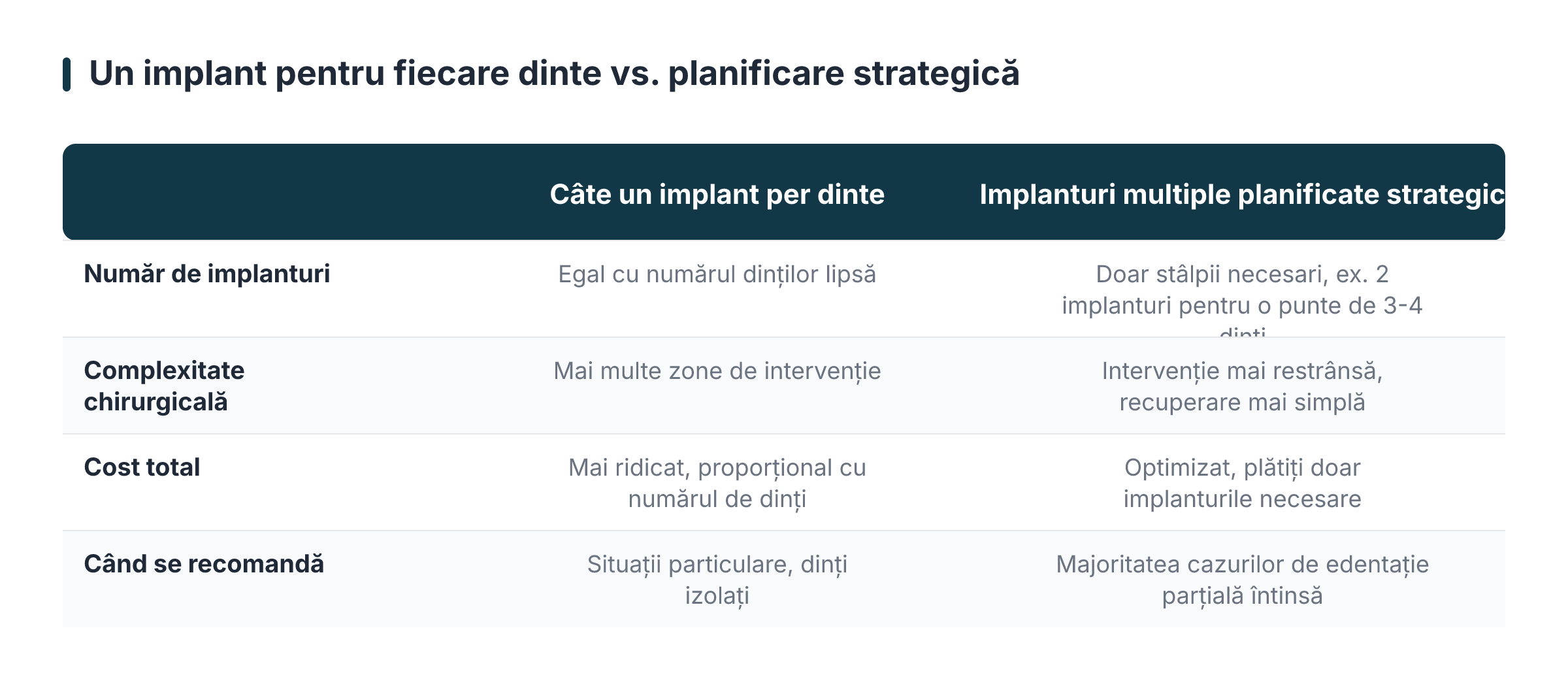
With multiple dental implants, you can replace anything from two adjacent teeth up to all the teeth in an arch, and the bottom line is that you don't need one implant for each missing tooth. Implants function as supporting pillars for the prosthetic restoration: two implants can support a bridge of three or four teeth, and a complete arch can be restored, depending on the case, on four to eight implants. The exact number is determined at the consultation, depending on the position of the missing teeth, the available bone volume and the masticatory forces in that area.
This confusion is one of the most common we encounter in our clinic on Pipera Road. Many patients with several missing teeth, a situation we medically call partial edentulism (the absence of some of the teeth), postpone the consultation because they imagine a double or triple cost compared to reality. In practice, the treatment plan for partial edentulism is almost always more effective than the sum of individual implants.
The good news is that modern implantology offers predictable solutions for almost any scenario: two missing teeth next to each other, several gaps spread across the arch, or missing all the lateral teeth. Only the architecture of the solution differs, not the ability to solve it.
Why isn't an implant needed for every missing tooth?
A dental implant is a titanium screw that replaces the tooth root and integrates into the bone. Once integrated, it can take on considerable masticatory forces, comparable to that of a natural tooth. Precisely for this reason, implants can be used as supporting pillars for bridges, just as healthy natural teeth can support a classic bridge.
Specifically, here are some scenarios we frequently encounter:
- Two adjacent missing teeth: usually two implants with two splinted crowns, but in certain situations and bone configurations an adapted solution can be discussed.
- Three or four missing teeth in the same area: two implants at the ends of the gap, supporting a bridge of three or four elements.
- Multiple gaps on the same arch: the position of the implants is strategically planned to cover all areas, with an optimal number of supporting implants.
- Complete edentulous arch: fixed restoration on four, six or eight implants, depending on the quality of the bone and the type of prosthetic restoration chosen.
There are also limits: we do not recommend excessively long bridges on too few implants, because the masticatory forces would overload the supporting implants. The balance between the number of implants and the extent of the restoration is exactly what the implantologist determines when planning, and here experience counts. In our clinic, which has been active since 2004, the principle is simple: we recommend the number of implants that the patient really needs, no more, no less.
What does the step-by-step treatment plan for multiple implants look like?
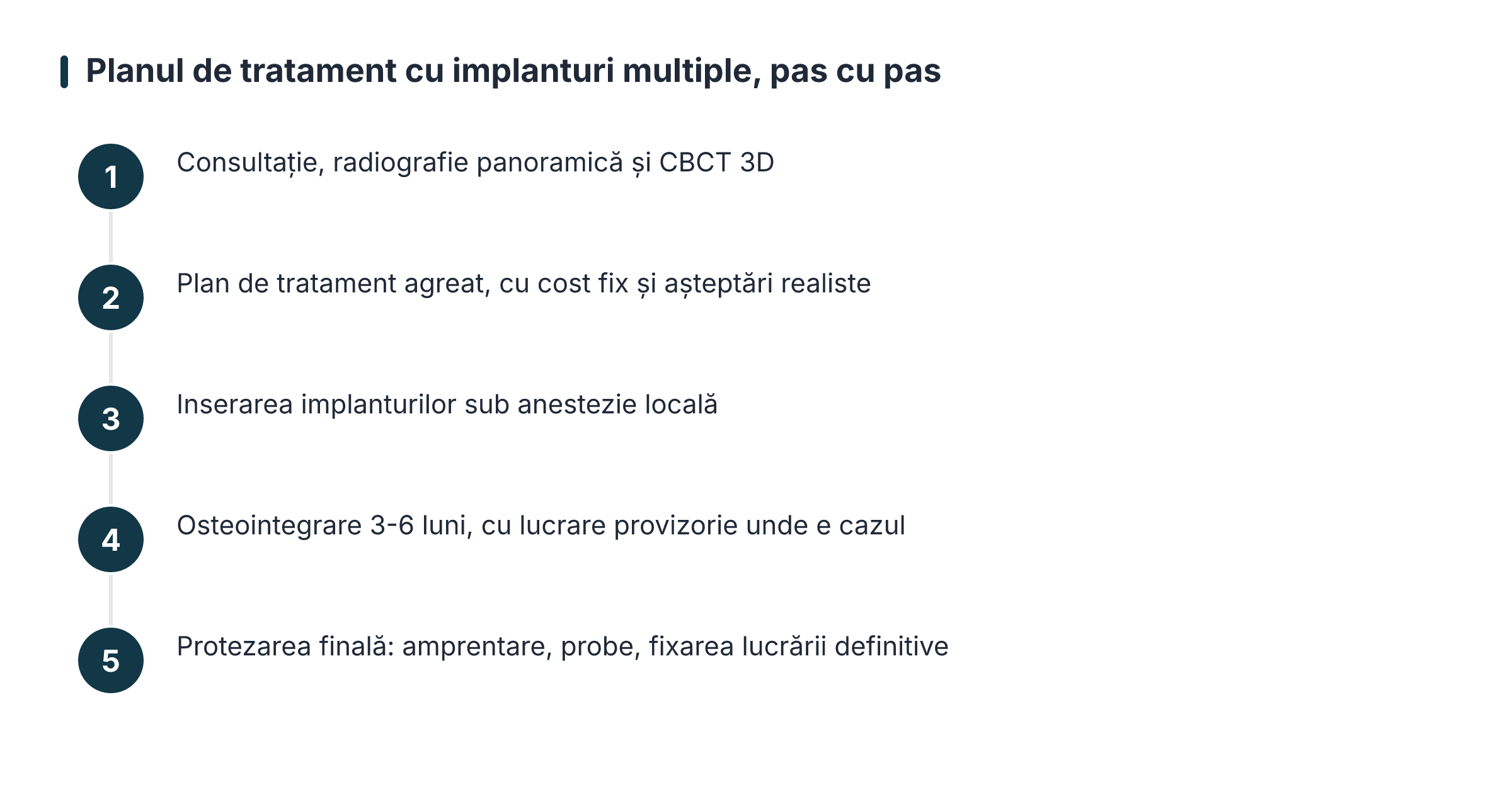
A dental implant treatment plan for multiple missing teeth follows a logical sequence of steps, and our patients appreciate understanding the entire process from the beginning. Here's how it goes, step by step.
1. Consultation and imaging investigations
Everything starts with a thorough consultation and a panoramic X-ray, usually supplemented with a CBCT (a 3D dental tomography) that shows us exactly the volume and density of the bone. Based on this data we determine how many implants are needed, where they will be positioned and if additional procedures are needed, such as bone grafting.
2. Treatment plan and discussion of expectations
We present the patient with the complete plan: number of implants, type of prosthetic restoration, stages, estimated duration and total cost. We explain from the beginning what realistic expectations they can have based on their situation, because a properly informed patient makes good decisions. Once the plan is agreed, the price remains the established one, if the treatment is carried out within a reasonable period of time.
3. Insertion of implants
The implants are inserted in an intervention performed under local anesthesia. When they are multiple, they can be inserted in the same session or in stages, depending on the treated areas and the general condition of the patient. The intervention is usually less demanding than patients imagine, and the initial recovery lasts a few days.
4. Osseointegration and final prosthesis
Next comes the osseointegration period, i.e. the integration of the implants into the bone, which generally lasts between three and six months. During this interval, in many cases, the patient can wear a temporary restoration, so that they are not left without teeth. At the end, prosthetics on implants are made: impressions, try-ins and fitting of the crowns or the definitive bridge.
What factors influence the number of implants and the cost of treatment?
Every treatment plan for partial edentulism is different, and several factors determine both the number of implants and the final cost:
- Position and distribution of missing teeth: a continuous gap can often be restored with fewer implants than several scattered gaps.
- Bone volume and quality: if bone has resorbed after tooth loss, bone augmentation may be required, which adds a step and cost.
- Functional area: the back teeth take on greater masticatory forces, so work in the lateral area needs more solid support.
- Type of prosthetic restoration: individual crowns, bridge on implants or full arch restoration have different costs and requirements.
- Condition of the remaining teeth: sometimes the plan also includes treatments on the natural teeth, for a stable long-term result.
We do not communicate prices without seeing the clinical situation, precisely because these variables significantly change the plan. What we can promise is transparency: the cost agreed at the beginning of the treatment does not change along the way, and the patient knows exactly what they are paying for at each stage. It is one of the reasons why patients who come to us through referrals stay with the clinic for years.
Why does clinic experience matter in cases with multiple missing teeth?
A single implant is a relatively standardized procedure. However, multiple implants for several missing teeth are a planning exercise: the position of each implant must be thought of in relation to the final prosthetic restoration, the patient's bite and the remaining teeth. Bad planning is difficult and expensive to correct.
Our team has been treating patients in Bucharest since 2004, and since 2014 in the location in Șoseaua Pipera, with skills certified by a master's degree in implantology. Our philosophy is that the patient's interest comes before the doctor's preferences: if a natural tooth can be saved, we say so openly, even if the implant would be the simpler solution for us. Similarly, if the situation calls for fewer implants than the patient expected, the plan reflects exactly what is needed.
We know that many patients check the clinic online before the appointment, even when they come with a clear recommendation, and we consider this natural for a treatment of this magnitude. We invite you to see the clinic's treatment rooms and equipment in our photo gallery, and to ask us all your questions during the consultation. A patient who understands the logic behind the diagnosis and treatment plan goes through the whole process with much more peace of mind.
When is the right time to take the first step?
The longer the teeth are missing, the more the bone in that area gradually resorbs, and neighboring teeth can migrate into the empty spaces. That doesn't mean it's ever too late, just that a plan started earlier is usually simpler and more predictable.
If you are missing several teeth and wondering how many implants would be necessary in your case, the first step is a consultation with imaging investigations. Only after we see the real situation can we respond concretely, with a phased plan and a cost established from the beginning. For patients from the Pipera area and from the north of Bucharest, our clinic is located on Pipera Road, and scheduling an evaluation consultation is the best way to turn a general question into a personalized answer.
Frequently Asked Questions
I have four missing teeth. Do I need four implants?
Not necessarily. If the four teeth are missing from the same area, two implants placed at the ends of the gap, which support a four-element bridge, are usually sufficient. If the missing teeth are spread over different areas of the arch, the number of implants may be higher. The exact configuration is determined after radiography and usually a CBCT, because the position and volume of available bone directly influences the plan. At the consultation, we present the possible options and our recommendation, with the arguments for each.
Can multiple implants be placed in the same session?
Yes, in most cases several implants can be inserted in the same intervention, under local anesthesia. This shortens the total duration of treatment and means only one recovery period. There are also situations where we prefer staging, for example when the treated areas require bone grafting or when the general condition of the patient recommends it. The decision is taken together with the patient, at the time of establishing the treatment plan, with a clear explanation of the advantages of each variant.
How long does the whole treatment with multiple implants take?
In general, from the insertion of the implants to the final prosthetic restoration, between three and six months pass, the period required for osseointegration, i.e. the integration of the implants into the bone. If bone grafting or prior extractions are needed, the total time may be longer. In many cases, the patient can wear a temporary restoration during this interval so that appearance and mastication are acceptable throughout treatment. We agree on an estimated timeline at the consultation, which we follow as closely as the clinical evolution allows.
Will I be left without teeth during the healing period?
In most situations, no. For visible areas there are temporary solutions, such as fixed or removable temporary restorations, which cover the spaces during osseointegration. The type of provisional depends on the treated area and the initial stability of the implants. We discuss this aspect from the very beginning of the treatment plan, precisely because we know that it is one of the main concerns of patients who work with the public or have an active social life.
Can the price set at the beginning change along the way?
In our clinic, no. Once the treatment plan is agreed, the cost remains the one communicated at the beginning, provided that the treatment takes place within a reasonable time frame. The only situation in which the plan can be adjusted is the discovery of a new clinical problem, unforeseeable at the time of planning, in which case we openly discuss the options before proceeding. We believe that financial transparency is part of the quality of the medical act, especially for extensive treatments carried out over several months.
Are multiple implants suitable at any age?
Implants can be made at any adult age, after bone growth is complete. More important than age are general health, bone quality and oral hygiene. Certain conditions, such as uncontrolled diabetes, or heavy smoking can influence healing and require careful evaluation. During the consultation, we analyze the complete medical history and tell you honestly if implants are the right solution for you or if there are alternatives that are more appropriate in your specific case.
More details: our dental implant page for Sector 1. See also the instalment payment options.
This article is informative and does not replace specialist consultation. For a personalized diagnosis and treatment plan, schedule a consultation.