

The short answer: when to choose the natural tooth and when to choose an implant
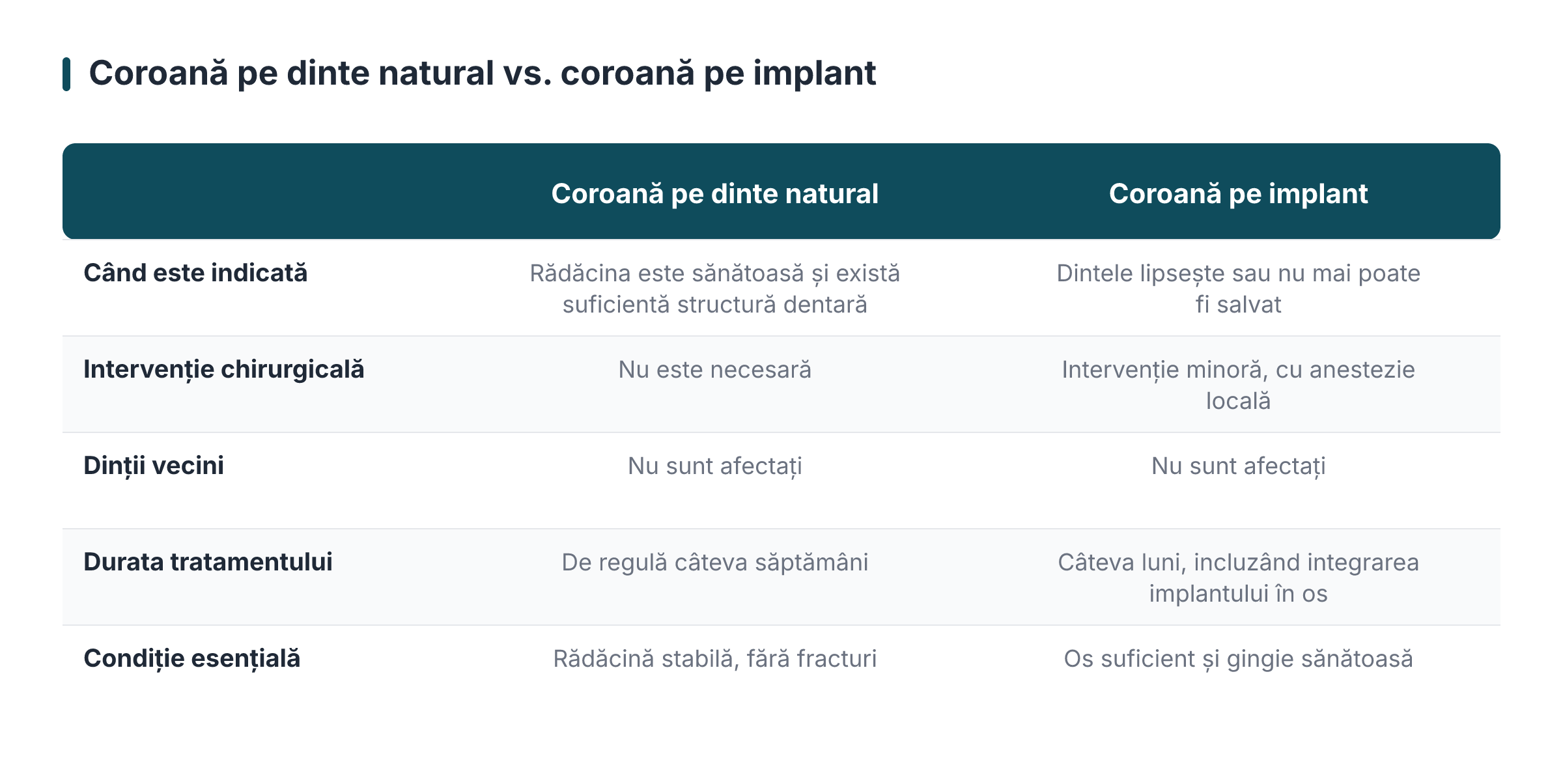
The choice between a crown on an implant and a crown on a natural tooth depends primarily on how much of your tooth can be safely saved. If the root is healthy, stable and there is enough tooth structure, the crown on the natural tooth is usually the first option, because you keep your own tooth. If the tooth is compromised, fractured below the gum or with infections that do not respond to treatment, a crown on an implant offers a stable long-term solution without affecting the neighbouring teeth. The correct decision is made only after a consultation with clinical examination and radiography, not according to general rules read online.
In our clinic in Șoseaua Pipera we work according to a simple principle, which we have applied since 2004: we recommend the treatment that is in the patient's interest, not the one that we like to do. Sometimes this means saving a tooth that someone else would have extracted, other times it means honestly saying that a tooth is no longer worth the investment and that an implant is the wiser choice.
When can the tooth be saved and what does a crown on a natural tooth mean?
A crown on a natural tooth is a protective cap, made of ceramic or zirconium, that covers the prepared tooth and restores its shape, function and appearance. Prosthetics on natural teeth remain an excellent solution when the base, i.e. the root and part of the crown of the tooth, is healthy.
In our practice, we consider a tooth worth saving when several conditions are met:
- The root is healthy and stable: no vertical fractures, no significant mobility caused by periodontal disease.
- There is sufficient tooth structure above the gum, or it can be rebuilt with a post so that the crown has something to rest on.
- The root canal treatment is correctly performed or can be redone, and the eventual infection at the root tip responds to the treatment.
- The crown-to-root ratio allows the tooth to absorb masticatory forces in the long term.
When these conditions are met, saving your own tooth has real advantages: you preserve the ligament that connects the root to the bone (the tooth "feels" the pressure of chewing in a natural way), the treatment is usually faster and does not require surgical intervention.
Why don't we insist on saving any tooth at any cost
There is also the opposite situation, where a tooth can be "patched" for another year or two, but with a poor prognosis. A tooth with a fractured root, extensive decay below the gum line, or recurrent infection after multiple root canals becomes a high-risk investment. In these cases, we openly explain to the patient that the money spent on saving the tooth could be lost, and the extraction followed by the implant is, in fact, the more appropriate option. Realistic expectations, said from the beginning of treatment, are part of our way of working.
When is a crown on an implant the right solution?
The dental implant is a titanium screw that replaces the root of the missing tooth. A prosthetic abutment and the actual crown are then attached to it. The crown on the implant becomes the right solution when:
- The tooth is already missing and you want to avoid preparing the neighbouring teeth for a bridge.
- Existing tooth can no longer be saved: root fracture, extensive destruction, high mobility due to bone loss.
- You have multiple missing teeth, where multiple implants can support stable bridges without overstressing the remaining teeth.
The major advantage of the implant is its independence: it does not rest on the neighbouring teeth and does not affect them. Additionally, the implant stimulates the bone it is inserted into, which helps maintain bone volume over time. The basic conditions are sufficient bone (quantitative and qualitative), healthy gums and general health compatible with minor surgery. All of these are evaluated at the initial consultation, with radiography or computed tomography.
You can see the environment in which we perform these treatments in the gallery of our clinic in Pipera.
Dental bridge or implant: what do we do when the tooth is already missing?
Many patients ask us if a dental bridge or implant is better when a tooth is missing. The dental bridge replaces the missing tooth resting on the neighbouring teeth, which must be prepared and covered with crowns. The implant replaces the missing tooth without touching the neighbouring teeth.
How we decide what to recommend in our clinic:
- If the neighbouring teeth are healthy, intact, without caries or large fillings, it is preferable not to prepare them. The implant is usually the more conservative choice.
- If the neighbouring teeth already have extensive damage or need crowns anyway, a bridge can elegantly solve three problems in one treatment.
- If the bone is insufficient for the implant and the patient does not want bone grafting (a procedure that rebuilds lost bone), the bridge remains a good and predictable solution.
- If several teeth are missing, prosthetics on implants avoid very long bridges, which overload the abutment teeth.
There is no universally valid answer. But there is a right answer for your situation, and it comes from examination, x-rays and an honest discussion about expectations, duration and budget.
How we reach the final decision in our clinic
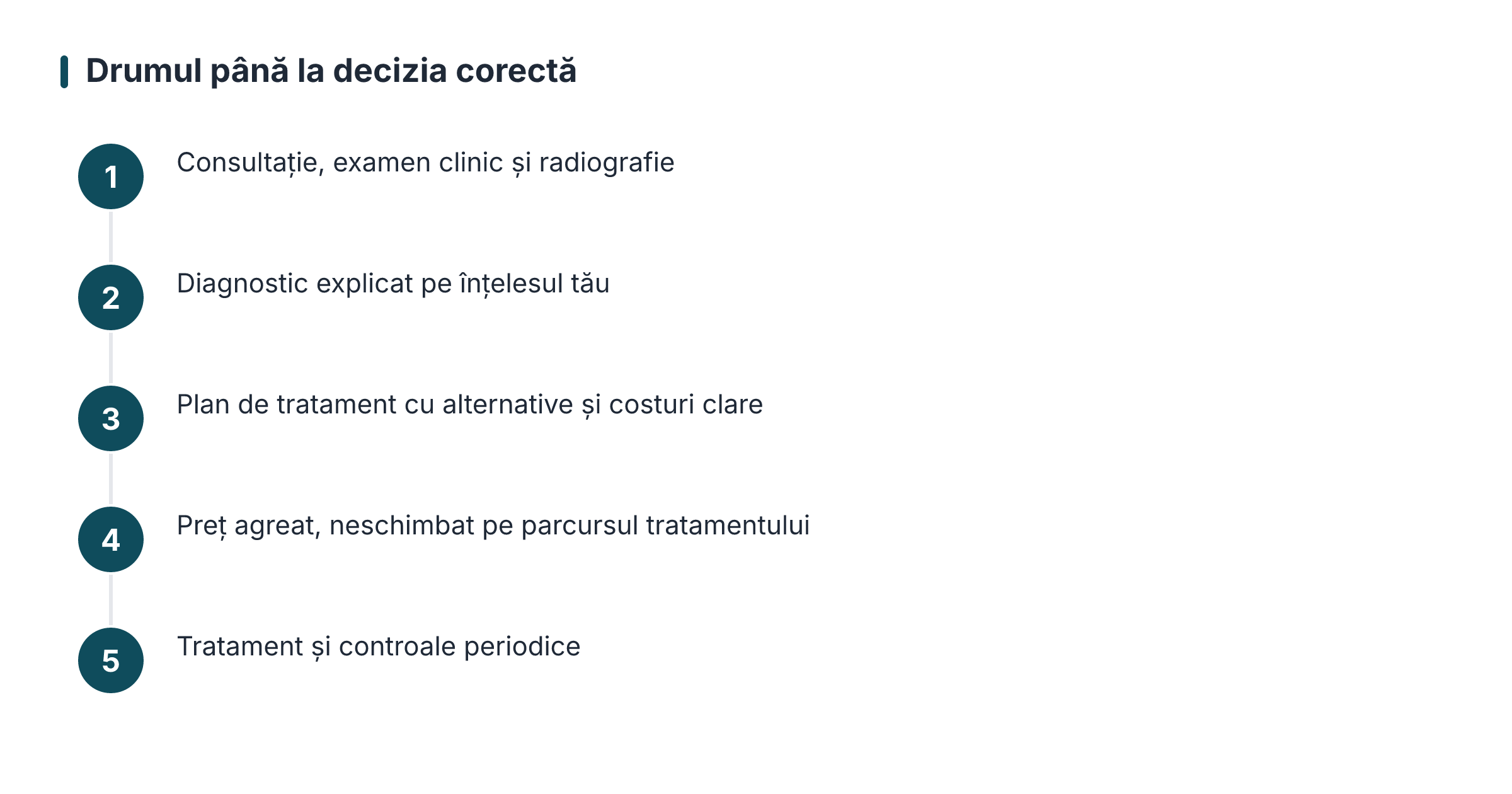
Patients who cross our threshold in search of dental treatments in Pipera especially appreciate the fact that we follow a logical thread, explained step by step. Here's how the process works:
- Consultation and investigations. We clinically examine the tooth and neighbouring teeth, perform the necessary x-ray and, where appropriate, a tomography to evaluate the bone.
- Diagnosis explained clearly. We show you exactly what we see and why, so you understand the situation, not just get a list of procedures.
- Treatment plan with alternatives. We present the realistic options (saving the tooth, implant, bridge), with the advantages, limits and costs of each.
- The agreed price remains unchanged. Once the plan is established, the price does not change during the treatment, if it is carried out within a reasonable interval.
- Treatment and follow-up over time. After completion, we establish periodic checks that protect your long-term investment.
This predictability is especially important in prosthetic and implantological treatments, where decisions made at the beginning influence the outcome for many years.
What influences the cost and duration of each variant?
Without going into numbers, which depend on each case, it is worth knowing what influences the cost and duration:
- Tooth condition and preparatory treatments: A tooth that requires root canal retreatment and a post will involve more steps than one that only needs a crown.
- The need for bone grafting before implant placement: if the bone has resorbed, rebuilding it adds time and cost, but ensures the stability of the implant.
- Crown material: Zirconia and pressed ceramic have different properties and costs.
- Number of teeth involved: a bridge on natural teeth involves a minimum of three crowns, while an implant with its crown replaces a single missing tooth.
In terms of duration, a crown on a natural tooth is usually completed in a few weeks. With the implant, there is a period of integration of the implant into the bone, which lasts several months before the definitive crown is fitted. We tell you from the beginning what timeframe to expect, so that you can organize your time without surprises.
If you have a compromised tooth or a missing tooth and you want to find out what is the right solution in your case, we welcome you for a consultation in our clinic in Șoseaua Pipera. You come with your questions, you leave with a clear diagnosis and a plan you understand.
Frequently Asked Questions
Is it better to save the tooth or to place an implant directly?
If the tooth has a healthy, stable root and enough structure to support a crown, saving it is usually the first option, because nothing is a perfect substitute for your own tooth. The implant becomes the right solution when the tooth has a poor prognosis: root fracture, extensive destruction or infections that do not respond to treatment. The decision is made individually, after clinical examination and radiography, weighing the real chances of success of each variant.
Does the implant treatment hurt more than the crown on the natural tooth?
Both procedures are performed with local anaesthesia, so that the discomfort during the treatment is minimal. The insertion of the implant is a minor surgical intervention, and in the following days there may be mild sensitivity, which can be controlled with usual pain medication. Preparing a tooth for a crown is also comfortable under anaesthesia. Most of our patients are surprised by how well they tolerate both procedures compared to their expectations.
How long does a crown on an implant last compared to one on a natural tooth?
Both solutions are designed for many years, and the lifespan depends more on hygiene, periodic checks and habits (eg bruxism, i.e. teeth grinding) than on the type of support. The crown on the natural tooth depends on the health of the underlying root, while the crown on the implant depends on maintaining the bone and gum around the implant. With proper hygiene and regular clinic visits, both variants have a very good long-term prognosis.
What if I don't have enough bone for the implant?
Lack of bone does not automatically mean the implant is out of the question. In many cases, the bone can be restored with a bone graft, a procedure in which bone material is added to the deficient area, either before or at the same time as the implant is inserted. This lengthens the overall duration of the treatment, but creates the necessary foundation. If you do not want bone grafting, we discuss realistic alternatives, such as a dental bridge on natural teeth, and together we choose the right option for your situation.
Do neighbouring teeth need to be prepared if I choose the implant?
No. This is one of the great advantages of the implant: it behaves like an independent root, and the crown is fixed directly on the implant, without touching the neighbouring teeth. In the classic dental bridge, the teeth on either side of the space must be prepared and covered with crowns, even if they are perfectly healthy. Therefore, when the neighbouring teeth are intact, we usually recommend the implant, to keep them intact.
Can the price change during treatment?
In our clinic, the price agreed in the treatment plan remains unchanged throughout the treatment, provided that it takes place within a reasonable time frame. It is one of our basic principles: the patient must know from the beginning what to expect, both medically and financially. If unforeseen situations arise along the way that would change the plan, we discuss them transparently before continuing.
More details: our dental implant page for Sector 1. See also our full price list.
This article is informative and does not replace specialist consultation. For a personalised diagnosis and treatment plan, book a consultation.