

Can braces be placed on adults?
Yes, adult braces can be fitted at any age as long as the teeth and supporting bone are healthy. Teeth can also move in a controlled manner at 30, 40 or 50 years old, because the biological mechanism by which the bone remodels around the root works throughout life. The difference with children is not whether the treatment works, but how long it lasts and how we plan it. In adults, orthodontic treatment requires a more careful evaluation of the gums, existing dental work and hygiene habits, but the results can be just as stable and beautiful.
In our practice in Bucharest, we see more and more adult patients who have postponed orthodontics since adolescence, either for financial reasons or because they did not want to wear a visible brace. The good news is that orthodontics for adults has changed a lot: today there are discreet options, precisely thought out for professionally active people who talk to clients, colleagues or partners every day.
An important point: there is no maximum age. The real condition is the condition of the periodontium, i.e. the tissues that support the tooth. That is why any adult orthodontic treatment begins in our clinic with a full consultation and, where appropriate, with hygiene and treatment of gum problems before placing the appliance.
How does orthodontics for adults differ from that for children?
Biologically, in children and adolescents, the jaw bones are still growing, and the orthodontist can use this growth to correct the relationship between the jaws as well. In adults, growth is complete, so tooth movement is done solely by remodeling the bone around the roots. This process is somewhat slower and requires gentler, constantly applied forces.
Basically, this means some differences that we take into account in the treatment plan:
- Slower movement rate: adult bone metabolism responds more slowly, so the same type of correction may take several months longer than in a teenager.
- More complex dental history: adults often have fillings, crowns, missing teeth, or root canals. All of this is integrated into the plan, sometimes in collaboration with prosthetic treatments or dental implants planned after teeth alignment.
- The health of the gums is a priority: an inflamed gum or an untreated periodontal disease stabilizes first, only then do we start moving the teeth.
- Excellent motivation and cooperation: major advantage of adults. The adult patient wears the aligners disciplinedly, comes for check-ups and takes care of his hygiene, which often compensates for the slower biological rhythm.
That is why we tell our patients from the first consultation what result they can realistically achieve in their specific situation. Sometimes the ideal correction would have required intervention in childhood, and in adulthood we get a very good but different functional and aesthetic compromise. We prefer to explain these limits at the beginning, not along the way.
What types of braces are suitable for adults and professionals?
The most frequent fear of 30-40 year old patients is not the pain, but the image: "how do I look at meetings, at presentations, in pictures?". Modern orthodontics has good answers to this question, and the choice depends on the complexity of the case, budget and lifestyle.
Transparent aligners (invisible gutters)
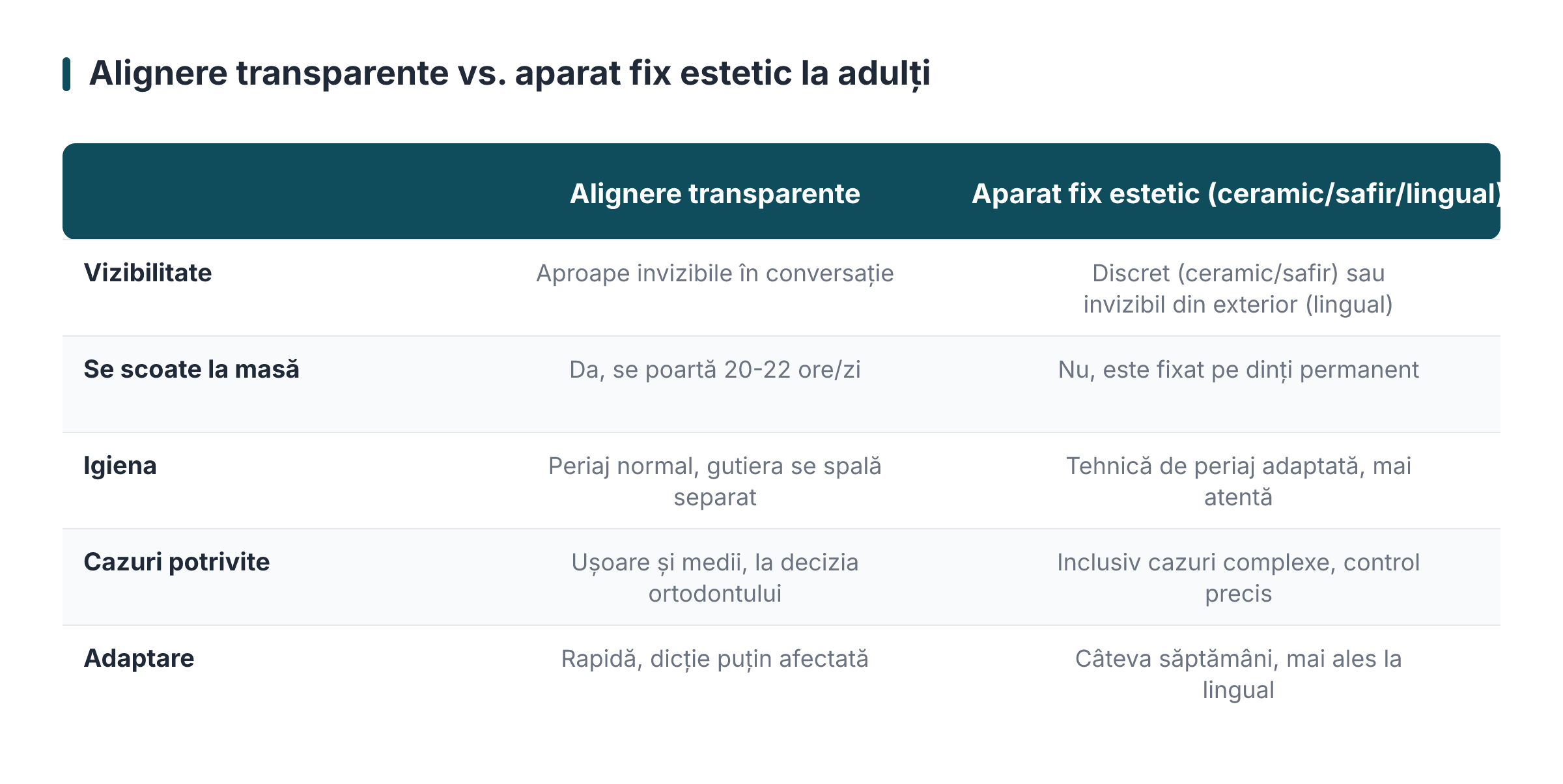
Aligners are transparent, almost invisible braces, worn 20-22 hours a day and periodically changed according to the digital plan. They are the preferred option of professionals because they come off at the table and brush, do not significantly affect diction and go unnoticed in most interactions. It works very well in mild and moderate cases; in complex cases, the orthodontist determines if they are sufficient or if a combined approach is needed.
Esthetic fixed appliances (ceramic or sapphire)
Fixed appliances with ceramic or sapphire brackets work like classic metal appliances, but are tooth-colored and much more discreet. They are a good choice when the case requires the precise control of a fixed appliance, and the patient still wants an aesthetic appearance. I ask for strict hygiene and the avoidance of very hard or sticky foods.
Lingual appliances
Lingual appliances are mounted on the inside of the teeth, towards the tongue, so they are practically invisible from the outside. They are the solution of choice for patients for whom total discretion is essential. It requires a period of speech and language adaptation, usually several weeks, and a more careful hygiene technique.
At the consultation we openly discuss the advantages and limits of each option for the specific case. Our principle, valid since 2004, is simple: we recommend the treatment that suits the patient, not the one that would suit us.
How long do braces last in adults?
On average, orthodontic treatment in adults lasts between 12 and 24 months, depending on the complexity of the case. Minor corrections, for example a slight crowding of the front teeth, can sometimes resolve within 6-12 months with aligners. Complex cases with missing teeth, significant rotations or bite problems may exceed 24 months. The exact duration can only be estimated after the consultation, radiography and analysis of the models.
What influences the duration of treatment in an adult:
- Initial complexity: degree of crowding, spacing or gap between the jaws.
- Chosen device type: some movements go faster with a fixed device, others are just as efficient with aligners.
- Discipline of wearing: when aligning, every day the brace is not worn enough prolongs the treatment.
- Gum health and hygiene: repeated inflammations may require breaks.
- Presence at check-ups: periodic visits, usually every 4-8 weeks, keep the treatment on the planned trajectory.
After the removal of the appliance comes the containment stage: a night splint or a thin wire glued to the inside of the teeth, which holds the result. In adults, retention is long-term, because teeth have a natural tendency to move throughout life. It is not a chore, but the insurance policy of the investment made.
How does orthodontic treatment proceed in our clinic in Pipera?
We are a family clinic, present on Pipera Road since 2014, with activity started in 2004, and orthodontic treatments are performed by the team's orthodontist. Patients who seek us from the Pipera, Aviatiei or Aurel Vlaicu areas appreciate that the treatment route is clear from the first visit. Those who want to see the environment in which we work can take a look at the gallery with images from our office in Pipera.
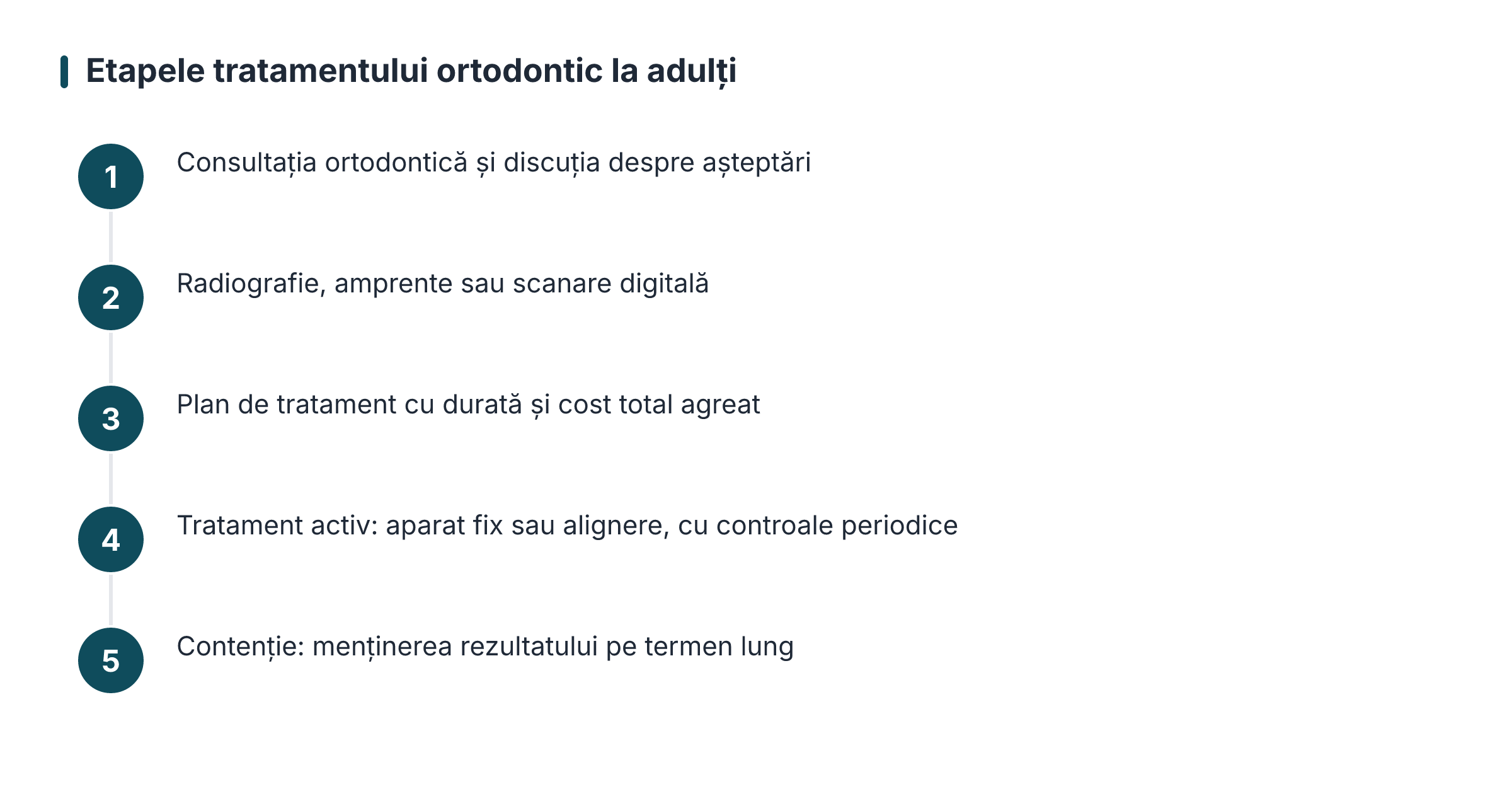
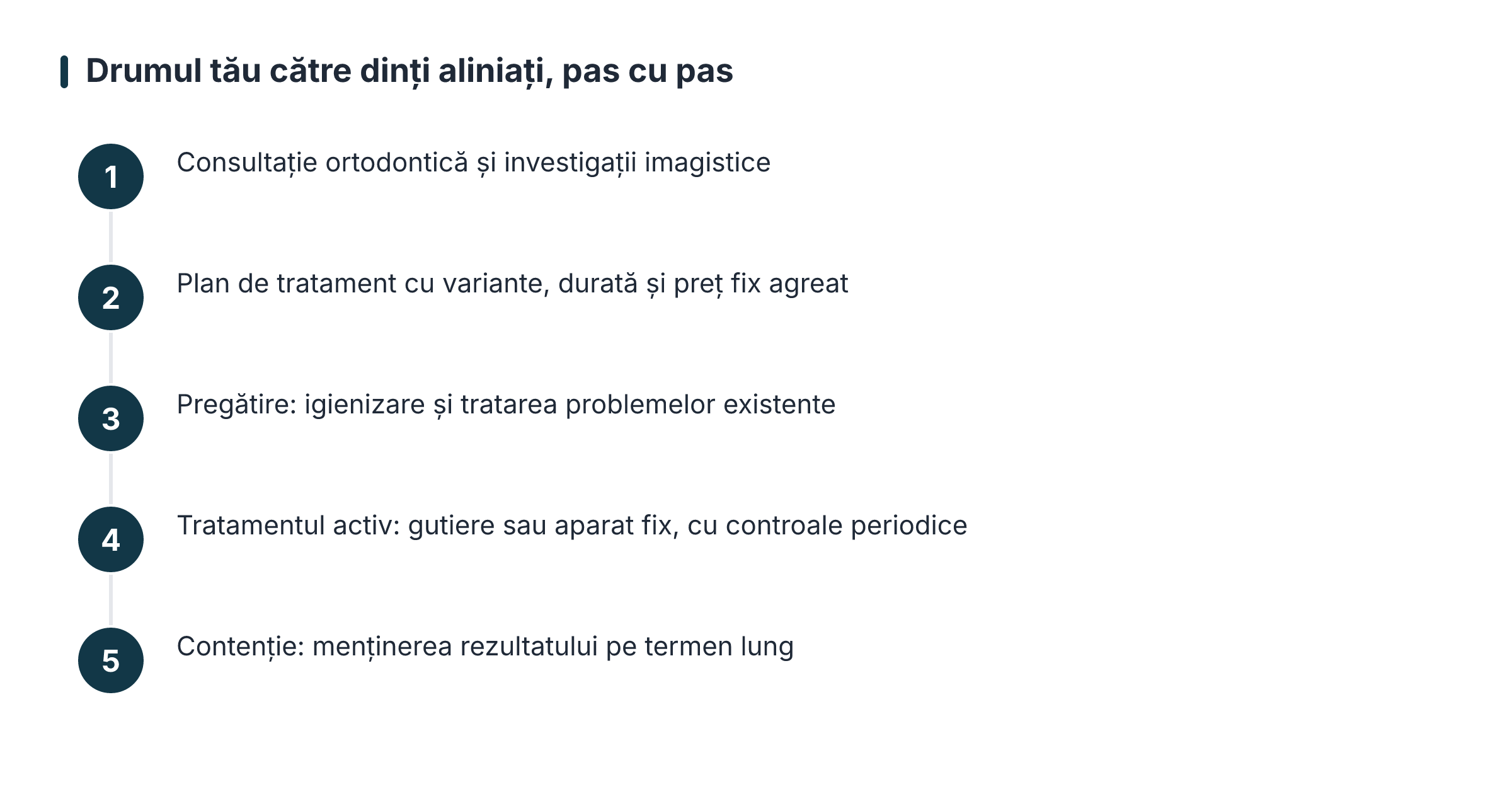
- Orthodontic consultation: we examine the teeth, gums and bite, discuss expectations and the real reason you want the treatment.
- Investigations: panoramic x-ray and, where necessary, other images and fingerprints or digital scan.
- Treatment plan: receive the options that suit your case, with estimated duration, stages and total cost. The price agreed at the beginning does not change during the treatment, if it takes place within the agreed interval.
- Active treatment: fitting the appliance or handing in the aligners, then periodic adjustment checks.
- Contention: maintaining the result after the treatment is completed.
A detail that matters for adult patients: we tell you from the beginning what expectations are realistic in your situation. If the ideal result requires other steps, such as replacing a missing tooth with an implant after alignment, you'll know that before you start, not at the end.
Are braces worth it at 30-40 years old? What you gain beyond aesthetics
Yes, for most adults with crowded teeth or an incorrect bite, orthodontic treatment is worthwhile, and the benefits go beyond a picture smile. Aligned teeth are easier to clean, thus reducing the risk of tooth decay and gum problems. A balanced bite correctly distributes masticatory forces, protecting the enamel, the joint and possible future prosthetic work.
- Easier hygiene: brush and floss reach where congestion blocked them for years.
- Protection of future work: crowns and implants are made more correctly on good alignment.
- Functional comfort: efficient chewing, less abnormal tooth wear.
- Confidence in interactions: many patients tell us after treatment that they smile freely in meetings and in photographs, without the reflex gesture of covering the mouth.
If you have asked yourself for years "isn't it too late for me?", the most honest answer you will find at an orthodontic consultation. In 45-60 minutes you can find out if you are a candidate, which device variants suit you and how long the treatment would realistically take in your case.
How does orthodontic treatment fit around a work schedule in Aviatiei or Pipera?
Much better than most patients think at the first consultation. Here is what the logistics of orthodontic treatment for an adult actually look like:
- The initial consultation takes about an hour and includes the examination, a discussion about your goals and, as a rule, imaging investigations. It is the only longer visit.
- Regular check-ups frequently take 15-30 minutes. With clear aligners they come every 6-8 weeks, with fixed braces somewhat more often.
- Scheduling can be arranged so you catch a window before the office, during your lunch break or at the end of the day, especially if you work in the area and don't lose time in traffic.
For someone with an office in Aviatiei, Pipera or near Aurel Vlaicu, an orthodontic check-up becomes a slightly longer coffee break, not a day off work. This is, honestly, one of the biggest differences from the way you remember it from adolescence, when monthly visits with your parents felt like a family project.
The total duration of treatment in adults varies from a few months, for mild crowding, up to two years or more for complex cases. We tell you the realistic timeframe for your case from the start, because we prefer honest expectations over pretty promises.
Frequently Asked Questions
Is there a maximum age for braces?
No. Teeth can move orthodontically at any age, because the bone around the roots remodels throughout life. The real condition is not age, but the health of the gums and supporting bone. We have patients who start orthodontic treatment even after 40 or 50 years, with stable results. Before fitting the appliance, we evaluate the periodontium and treat any gum problems, then the treatment is similar to that of a younger patient, only planned a bit more carefully.
Do braces show if I work with clients daily?
There are options designed exactly for this scenario. Clear aligners are almost invisible in conversation and can be removed at the table or before an important presentation. Ceramic or sapphire fixed appliances are tooth-colored and inconspicuous from normal conversational distance. Lingual appliances, mounted on the inside of the teeth, are not visible from the outside at all. At the consultation, we show you each option and together we choose the solution that suits your case and lifestyle.
How long does aligner treatment last for adults?
Depends on the complexity of the case. Mild front teeth corrections can take 6-12 months, while average cases frequently reach 12-18 months. Discipline is essential: the aligners must be worn approximately 20-22 hours a day, removed only for meals and brushing. Each day of insufficient wear prolongs the treatment. The exact duration for your case is estimated after consultation, x-ray and digital planning of dental movements.
Do braces hurt in adults?
It is normal to feel pressure and tenderness when chewing in the first few days after fitting or after each activation and after each new mouthpiece. This sensation shows that the teeth have started to move and usually give way within a few days. Most adult patients describe it as manageable discomfort, not pain that affects work or sleep. If necessary, a usual pain reliever recommended by the doctor is sufficient during the adaptation period.
Can I get braces if I have crowns, fillings or missing teeth?
In most cases, yes, but the plan is customizable. Teeth with fillings or root canal treatments can move orthodontically, and existing crowns are taken into account when choosing the type of appliance. If you have missing teeth, orthodontics is often planned together with the prosthetic stage: first we align the teeth and prepare the correct space, then the implant or prosthetic work is done. That's why the initial consultation includes a complete evaluation, not just the alignment of the teeth.
Can the price set at the beginning change along the way?
In our clinic, the price agreed in the treatment plan does not change during the treatment, as long as it is carried out in the time interval agreed together. Get the total cost, milestones and estimated duration from the start so you can make an informed decision. If an unforeseen situation arises along the way that would change the plan, we discuss it transparently before any additional work, never after.
More details: our full price list. See also the clinic’s contact details and opening hours.
This article is informative and does not replace specialist consultation. For a personalized diagnosis and treatment plan, schedule a consultation.