

What does it mean to be a good dental implant candidate?
You are most likely a good candidate for a dental implant if you have one or more missing teeth, healthy gums, enough bone in the area, and a stable general health. Age matters less than you think: it is important that bone development is complete and that any chronic conditions are kept under control. The definitive answer can only be given by a specialist consultation with three-dimensional radiography, because each clinical situation is different.
In our practice in Sector 1 of Bucharest, on Pipera Road, we see patients every day who come convinced either that the implant is the only solution, or that they have no chance of receiving it. The truth is, most of the time, somewhere in the middle. A dental implant is an artificial titanium root, inserted into the jawbone, on which a crown is later attached. Like any surgical intervention, it has clear conditions for success, and our role is to verify that these conditions are met before recommending treatment.
Our philosophy, unchanged since 2004, is simple: we only recommend treatments in the patient's interest, not those that would suit us. Sometimes that means telling a patient that an implant is not the best option for them right now.
What medical criteria do we check before recommending an implant?
Eligibility for the implant is established on the basis of several objective criteria, which we systematically evaluate in each patient. Neither is, on its own, an automatic condemnation or approval, but together they paint the full picture.
Bone density and volume
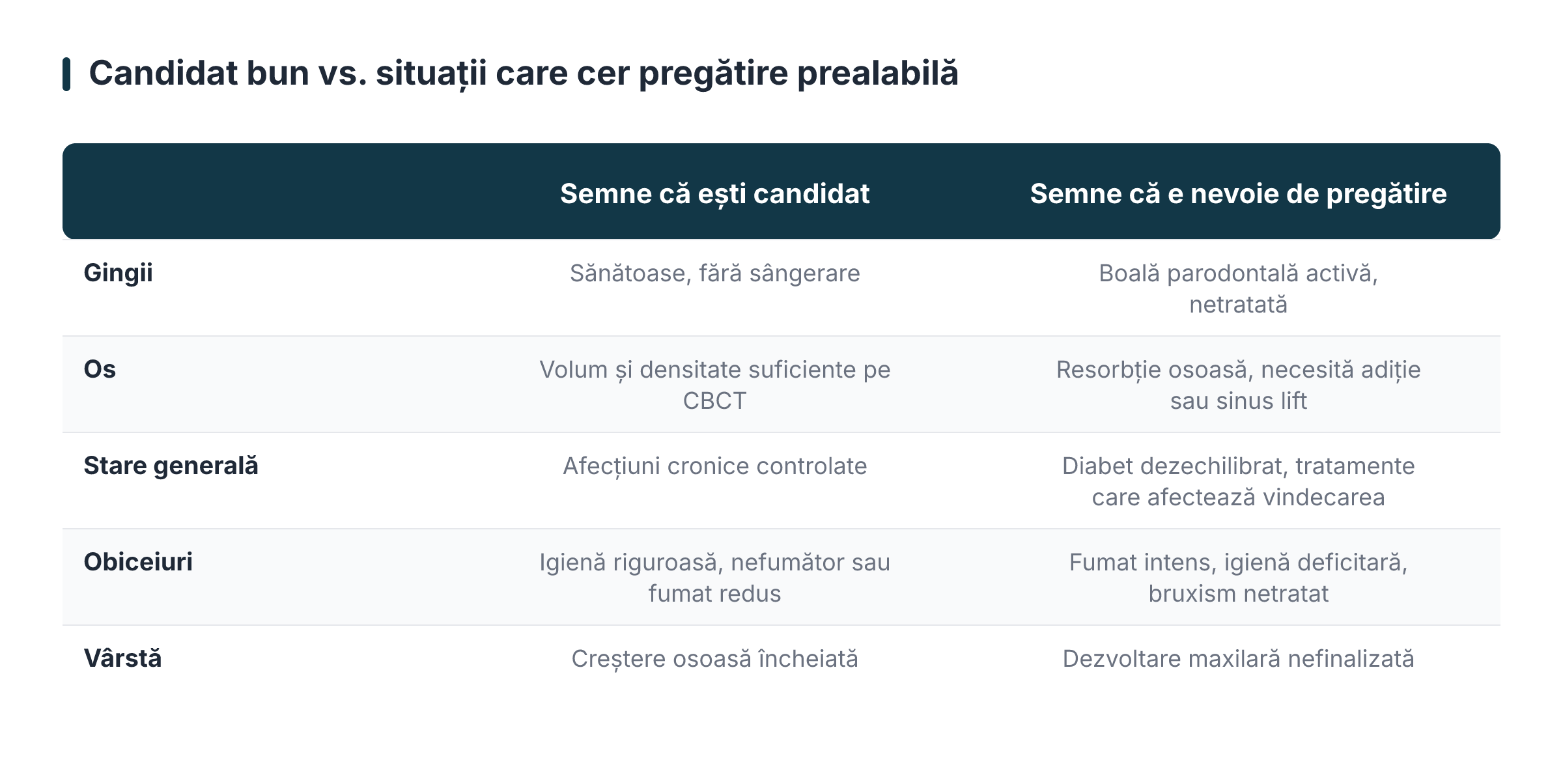
The implant needs a bone bed that is high, wide and dense enough to integrate stably. After a tooth is extracted, the bone in the area gradually resorbs, which is why patients who lost teeth many years ago may have reduced bone volume. We evaluate this on a CBCT radiograph (a three-dimensional dental tomography), which shows us to the millimeter how much bone there is and where the important anatomical structures are, such as the mandibular nerve or the maxillary sinus.
The good news: insufficient bone does not necessarily mean that the implant is out of the question. There are bone addition or sinus floor lifting procedures (sinus lift) that can restore the necessary volume. However, they extend the total duration of the treatment, and this must be known and accepted from the beginning.
Gum health and oral hygiene
Healthy gums are the foundation of any successful implant. Active periodontal disease (chronic infection of the tissues that support the teeth) is one of the main causes of implant failure, because the same bacteria can also attack the tissue around the implant. Therefore, if we identify periodontitis, we first treat this problem and only then discuss the implant.
Equally important is the patient's commitment to daily hygiene and periodic check-ups. An implant does not cause cavities, but the tissue around it can become inflamed if plaque is not properly removed.
General health status
Certain general conditions influence the healing and integration of the implant into the bone:
- Uncontrolled diabetes slows healing and increases the risk of infection; well-balanced diabetes, on the other hand, is usually not a contraindication.
- Osteoporosis and bisphosphonate treatments require careful evaluation and sometimes collaboration with the treating physician.
- Smoking significantly reduces the chances of implant integration; it's not an absolute ban, but we openly discuss the risks.
- Immunosuppressive treatments or radiotherapy in the head and neck area require additional caution.
That is why we ask you in detail about your medical history and the medications you are taking at the consultation. Not out of curiosity, but because this information can change the treatment plan.
What are the signs that you are NOT an implant candidate for now?
Being fair to the patient also means saying clearly when the implant is not the right choice at that time. Here are the situations in which we recommend postponement or another solution:
- Active, untreated periodontal disease: inserting an implant into an infected environment compromises its chances of success.
- Diabetes or other chronic conditions out of control: first we stabilize the general condition, together with the attending physician.
- Unfinished bone growth: in teenagers and very young adults we wait for jaw development to complete.
- Heavy smoking without the willingness to cut down: the risk of failure increases considerably, and the patient must understand this trade-off.
- Poor oral hygiene and lack of controls: the implant requires the same discipline as natural teeth, if not more.
- Severe untreated bruxism (teeth grinding): excessive forces can overstress the implant; we often solve this problem first, for example with a gutter.
Important to note: Most of these conditions are temporary or treatable. "Not now" does not mean "never". Many of our patients who initially did not qualify became very good candidates after a periodontal preparation or general balancing step.
How does the dental implant evaluation consultation proceed in Bucharest?
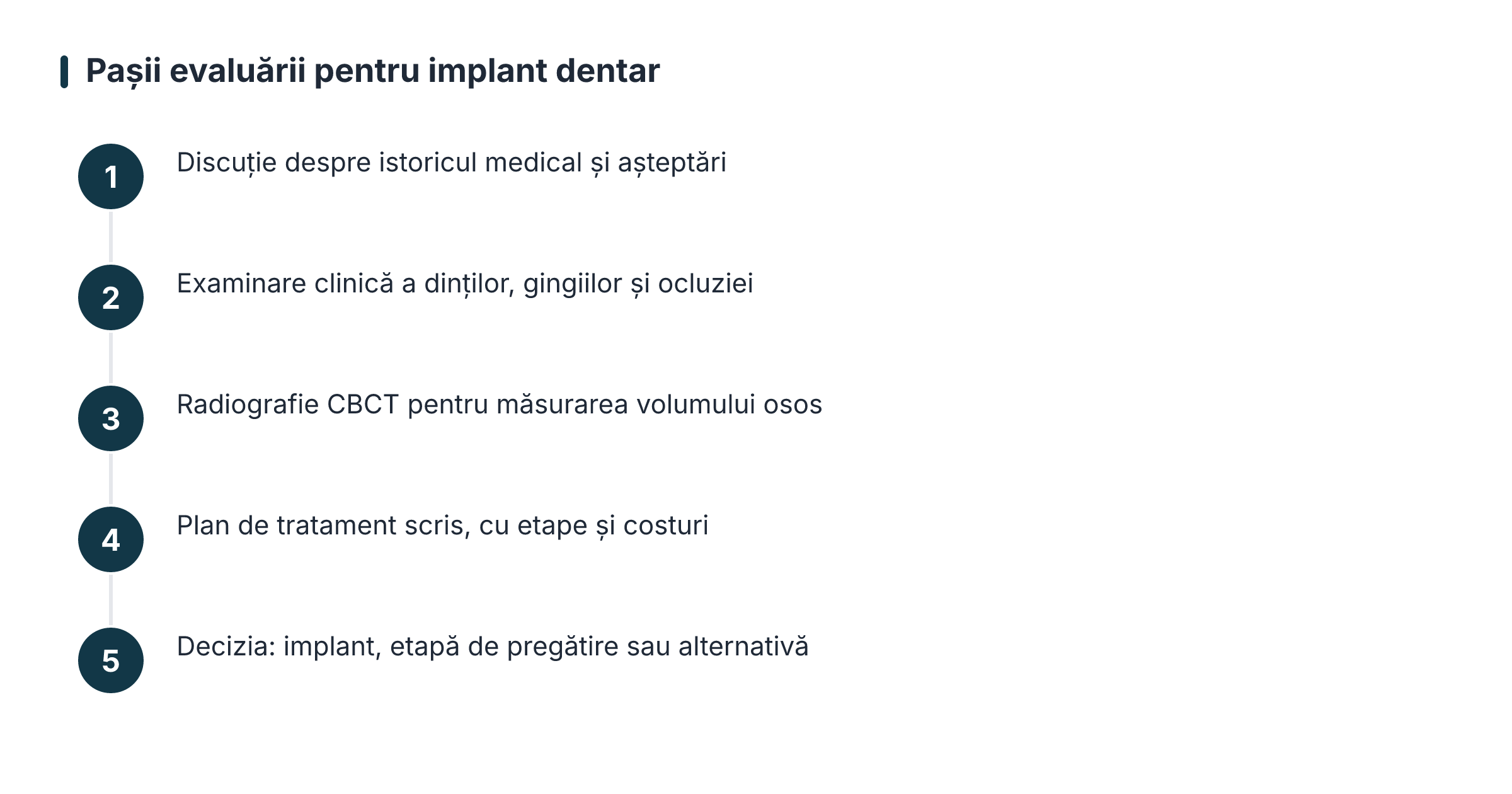
A proper implantology consultation is not limited to a quick look in the mouth. When evaluating dental implant we go through several clear steps:
- Discussion about medical history and expectations: we find out what is bothering you, what conditions you have and what outcome you want.
- Clinical examination: we check the teeth, gums, occlusion (the way you bite) and the space available for the future crown.
- CBCT radiography: we measure the bone volume and plan the exact position of the implant.
- The written treatment plan, with steps and costs: we explain the options, the duration and what realistic expectations you can form according to your situation.
A principle we adhere to from day one in our location in Pipera, where we have been since 2014: the price agreed at the beginning of the treatment remains unchanged throughout, if the treatment is carried out within a reasonable interval. No surprises on the invoice at the end.
Patients who check us out online before the appointment, a habit we encourage, can view the clinic gallery to get an idea of the office and equipment before the first visit.
What alternatives are there if the implant is not right for you?
The implant is, in many cases, the solution with the best longevity for replacing a missing tooth, but it is not the only one. Depending on the clinical situation and the patient's priorities, we also discuss:
- Dental bridge on natural teeth: the crowns rest on the teeth neighboring the free space; is a fixed, faster solution, but it involves grinding the post teeth.
- Partial or full denture: a mobile option, suitable when many teeth are missing and implants are not feasible for medical or anatomical reasons.
- Prosthodontics on multiple implants: in patients with extended edentulous teeth, a few strategic implants can support an entire bridge, without placing an implant for each missing tooth.
- Preparation stage: periodontal treatment, bone addition or balancing of general conditions, followed by reevaluation for implant.
The choice is not made according to the catalog, but according to your specific situation. Our role is to honestly present you the advantages and limitations of each option, and the final decision is yours, made with knowledge of the case.
Why does it matter where you do your implant assessment in Sector 1?
For patients looking for a dental implant in Sector 1 of Bucharest, in the Pipera or Aurel Vlaicu area, our recommendation is to choose the place of evaluation as carefully as the treatment itself. A proper assessment means three-dimensional imaging, a step-by-step treatment plan and a doctor willing to tell you when the implant is NOT indicated.
Our team has been working in implantology for over two decades, and the experience accumulated since 2004 has taught us one essential thing: satisfied patients are those who have received realistic expectations from the beginning, not beautiful promises. If you're wondering which category you fall into, the safest answer comes from an assessment consultation. We are waiting for you in our clinic on Pipera Road to analyze together, calmly and with all the data on the table, if the dental implant is the right solution for you.
Frequently Asked Questions
Is there an age limit for dental implant?
There is no upper age limit. We have successfully treated patients at advanced ages, as long as the general state of health allows minor surgery and healing proceeds normally. The real limit is the lower one: the implant is inserted only after the end of bone growth, usually after 18-20 years. In elderly patients, we carefully evaluate medication and chronic conditions, but age itself is not a contraindication.
Can I get an implant if I have diabetes?
Yes, in most cases, provided the diabetes is well controlled. A balanced diabetes, confirmed by recent tests and possibly by a discussion with the diabetologist, usually allows the implant to be inserted safely. Uncontrolled diabetes, on the other hand, slows healing and increases the risk of infection, so we recommend stabilizing blood sugar levels first. At the consultation, we will ask you for details about the treatment and the latest analyses, precisely to plan the intervention under optimal conditions.
What if I don't have enough bone for the implant?
Lack of bone does not automatically mean the implant is out of the question. There are augmentation procedures, such as bone addition with biomaterials or raising the floor of the maxillary sinus (sinus lift), which restore the necessary volume. These stages extend the total duration of the treatment by several months, because the new bone must mature before or in parallel with the insertion of the implant. The CBCT X-ray shows us exactly how much bone you have and what procedure is right, and we explain the full plan to you before you start.
Does smoking completely rule out my dental implant?
It is not an absolute ban, but smoking reduces the chances of implant integration and increases the risk of long-term complications, because it affects blood circulation in the gum and bone healing. We openly explain these risks to smoking patients and recommend that they reduce or stop smoking at least during the healing period. The final decision is taken together, knowingly, after evaluating the complete clinical situation.
How long does the assessment take and when do I find out if I am a candidate?
As a rule, you find out the answer at the very first consultation. The discussion of the medical history, clinical examination and CBCT X-ray gives us most of the information needed to tell if you are a candidate, if you need a preparatory stage or if another solution is more suitable. You leave us with a written treatment plan, with clear stages, duration and costs, and the agreed price remains unchanged during the treatment carried out in a reasonable interval.
If I am not a candidate now, can I become one in the future?
Yes, in many cases. Most contraindications are temporary or treatable: periodontal disease can be treated, bone can be restored by addition, diabetes can be balanced, and bruxism can be managed with a brace. Many of our patients who initially did not qualify became good candidates after a few months of training. That's why we prefer the wording "not now" instead of "never" and together we determine the concrete steps until the reevaluation.
More details: our dental implant page for Sector 1. See also the instalment payment options.
This article is informative and does not replace specialist consultation. For a personalized diagnosis and treatment plan, schedule a consultation.